September 30th is Canada’s official National Day for TRUTH and Reconciliation, but before it was a federal holiday it was know as Orange Shirt Day. While every day should be Orange Shirt Day, I thought today was a good time to revisit some Canadian Indigenous contributions to knitting.

Indigenous Designer: Jessie Mae Martinson
I found some gorgeous patterns by Jessie Mae Martinson, an incredibly talented indigenous designer from the US (I tracked her down through BIPOC in Fiber). She designs pretty little tops & bottoms, great for warm weather. Her patterns are size inclusive and priced on a “choose what you pay” scale.
To make the sweater above choose a fingering weight yarn (Cascade Heritage, Artfil Belle, Fibre Co Amble, Fleece Artist Merino Slim are all perfect, Fibre Co Meadow would also be lovely) as the base and pair it with a fuzzy yarn like Drops Kid Silk. The base yarn will be the dominant colour and the mohair will create a halo effect.

Indigenous Designer: Jennifer Berg
Jennifer Berg is another great Indigenous knitwear designer! Jennifer wants to bring Native American design into the Knitting Community and represent her people (Dine) with enthusiasm and inclusion.She shares her culture and encourage others to learn more about the Native people that live in the surrounding areas. She loves being Navajo and believes that the movement for inclusion of all Races, genders, and ethnicities in the knitting community is important and such an example to the rest of the world that people can and will fight for one another with Love. Also 5% of all of her self published patterns go to the Coalition to Stop Violence Against Native Women & Children
https://www.csvanw.org/
To make Jennifer’s Sheep Camp Sweater (above) you’ll need a double knitting weight yarn, like Sandnes Garn Double Sunday or Berroco Vintage DK.

Stories & Patterns: Sylvia Olsen
I also came across the book, Knitting Stories: Personal Essays and Seven Coast Salish-inspired Knitting Patterns (2014) by Sylvia Olsen, which you can buy as a Ravelry Download or as a soft cover from Sononis Press. You can also download 7 of the patterns individually. Alexa Ludman of Tin Can Knits highly recommends the book!
Olsen is non-native, but has spent much of her life living in Tsartlip First Nation, where her children and grandchildren now live. She is also author of the very recently published Unravelling Canada: A Knitting Odyssey (2021) and Working with Wool (2010), which received the Lieutenant-Governor’s Medal for Historical Writing. She has several knitting patterns available as downloads on Ravelry. I’ve only just discovered Olsen’s work, but if you’ve read her books please let me know what you thought!
I also found an interview with Sylvia Olsen on the Cabin Boy Knits Podcast!

Infinity Scarf
If you want to make the cowl above, I suggest using Cascade Heritage in colours 5742 Silver Grey Heather, 5631 Charcoal Heather, and 5672 Black. This pattern also includes a link to a video of Sylvia Olsen demonstrating Intuitive Colourwork (I don’t know what that is either, but it sounds interesting, I might have to buy the pattern to find out).
It would also be GORGEOUS made with Fibre Co Amble in Scaefel Pike (light brown), Fair Hill (medium brown), and Saddleback Slate (dark grey) …. the colours are all heathered, so they keep that ‘sheepy’ look, but they are soft as a puppy, so you can skip the itchy, sheepy feel.
West Coast Cardigan
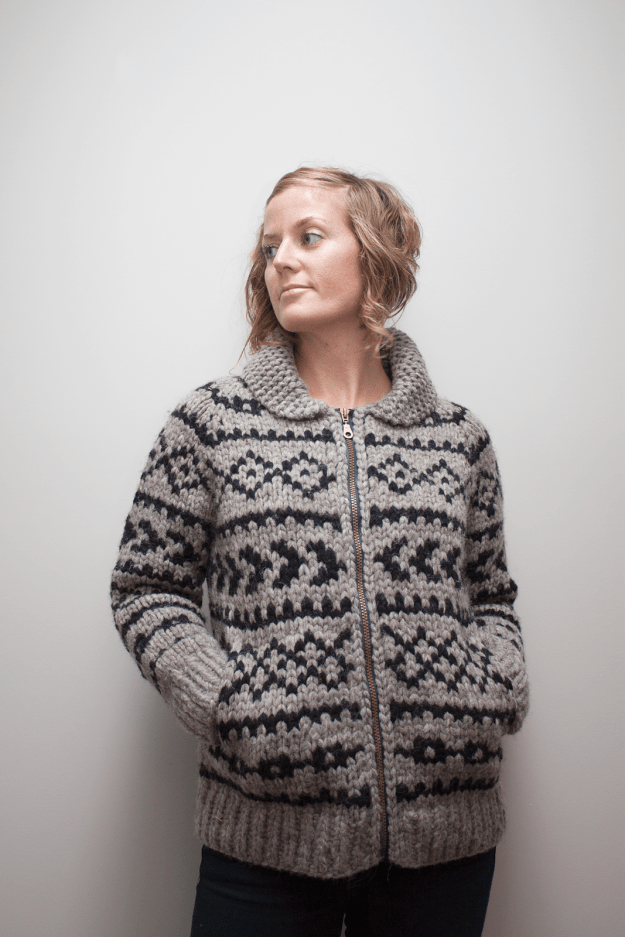
Should you now be feeling inspired to whip up your own Cowichan sweater, consider Canadian designer Jane Richmond’s West Coast Cardigan, which is not a real Cowichan sweater, but is respectfully inspired by the traditional style of the Cowichan Sweaters of the Coast Salish people. I suggest using Drops Andes, or for a more contemporary look try a blown yarn like Drops Wish.

More Insight: Articles & Documentaries
For those who are academically inclined or just want more context, I also found a journal article from 2012: The Coast Salish Knitters and the Cowichan Sweater: An Event of National Historic Significance, by Marianne P. Stopp. You can download it HERE (it takes a few seconds to load the site) or HERE.

And if journal articles aren’t your speed, I also found a nice little article in a lifestyle Magazine from Victoria: The Story of the Cowichan Sweaters.

A Canadian Indigenous Knitting Tradition
I also came across an older documentary made in 2000 for the NFB about the Coast Salish Knitters. I like this film, it’s older, but it addresses the complicated and often exploitative history connected with the makers of these sweaters. For us knitting is a leisure activity, but it’s important to keep in mind that for many of the families involved in the production of these sweaters, knitting meant the difference between starving and survival.
