This gentle giant is a gorgeous single-ply yarn spun from 100% wool. Soft, warm & cozy, Crazy Sexy Wool knits up quickly into stunning hats & dramatic scarves & mittens. This yarn is also a fun choice for outerwear ponchos or cardigans.
We’ve been playing around with the new Sirdar Jewelspun with Wool Chunky Because I knew it would be great for a baby blanket, toddler blanket, or a throw blanket. Luckily, the designers at Sirdar think like me and also love a good Missoni-inspired chevron/ripple blanket!
Drops Fiestais a vibrant and long wearing, sock-blend yarn that is superwash treated, which makes it machine washable and easy to care for. A fun and colourful all-round yarn that is warm and soft to the touch and suitable for far more than socks; try it on sweaters, cardigans, scarves and hats (the only thing you can’t do is felt it)!
To soften the look of a multi-coloured yarn you can hold it with a strand of kid-mohair or lace-weight alpaca, like Drops Kid-Silk or Mode at Rowan Alpaca Haze.
Machine wash in cold water, gentle cycle, no fabric softener. Lay flat to dry.
Made in EU
Raw material origin: Wool from South America, polyamide from Germany
Confetti Cardigan Mini
Confetti Cardigan is knitted top down, starting with the back yoke which is worked back and forth (while shaping the shoulders with short rows). After that sts are picked up across the shoulders to form the front yoke with neckline shaping, then the rest of the body is worked back and forth till it’s finished. Sts for sleeves are then picked up and worked in the round. Sts for the front edging are picked up and then worked in double knitting, finally a decorative applied icord is worked over the top inner back of the cardigan.
Difficulty level: Advanced
This is a technical garment pattern intended for experienced knitters. Requires confidence with complex construction and finishing techniques, including double-knitting. Not suitable for beginners or first garments.
Techniques: Long tail cast on purl wise, German short rows, Picking up sts, Brioche Increase, Brioche Decreases, Italian cast on and bind off
Size
3-6m (6-12m, 12-18m, 18-24m, 2-3yrs, 3-4yrs).
Chest Circumference (closed): Approximately 58 (62, 66, 70, 72, 76) cm / 22.8 (24.4, 26, 27.5, 28.3, 29.9) inches.
Confetti Cardigan is knitted top down, starting with the back yoke which is worked back and forth (while shaping the shoulders with short rows). After that sts are picked up across the shoulders to form the front yoke with neckline shaping, then the rest of the body is worked back and forth till it’s finished. Sts for sleeves are then picked up and worked in the round. Sts for the front edging are picked up and then worked in double knitting, finally a decorative applied icord is worked over the top inner back of the cardigan.
Difficulty level: Advanced
This is a technical garment pattern intended for experienced knitters. Requires confidence with complex construction and finishing techniques, including double-knitting. Not suitable for beginners or first garments.
Techniques: Long tail cast on purl wise, German short rows, Picking up sts, Brioche Increase, Brioche Decreases, Italian cast on and bind off
Confetti Cardigan is knitted top down, starting with the back yoke which is worked back and forth (while shaping the shoulders with short rows). After that sts are picked up across the shoulders to form the front yoke with neckline shaping, then the rest of the body is worked back and forth till it’s finished. Sts for sleeves are then picked up and worked in the round. Sts for the front edging are picked up and then worked in double knitting, finally a decorative applied icord is worked over the top inner back of the cardigan.
Difficulty level: Advanced
This is a technical garment pattern intended for experienced knitters. Requires confidence with complex construction and finishing techniques, including double-knitting. Not suitable for beginners or first garments.
Techniques: Long tail cast on purl wise, German short rows, Picking up sts, Brioche Increase, Brioche Decreases, Italian cast on and bind off
Photo: caseyoknits on Ravelry, shown in colour 22 Fairytale
Monday Sweater
The Monday Sweater is worked from the top down with raglan increases to shape the yoke. The neck rib edge is folded and knitted together (to form a double neckband) and short rows are worked at the back of the neck to shape the neckline and raise the back. The sleeves are worked in the round on double-pointed needles or on a circular needle using the Magic Loop technique.
NOTE: If you are using Drops Fiesta you can knit with a single strand, you do not need to hold this yarn with another strand of Kid-Mohair, as suggested in the pattern (but you can add it if you want it extra fuzzy).
The Oslo Hat is worked from the bottom up in stockinette stitch. The first part of the hat is worked on a 40 cm [16 inches] circular needle, while the top of the hat is worked either on double-pointed needles or on a circular needle using the Magic Loop technique.
NOTE: If you are using Drops Fiesta you can knit with a single strand, you do not need to hold this yarn with another strand of Kid-Mohair, as suggested in the pattern (but you can add it if you want it extra fuzzy).
Size
baby (child) junior small (junior large) adult S (adult M) adult L
Measurements: Fits head circumference 47-48 (49-50) 51-52 (53-54) 55-56 (57-59) 60-63 cm 18½-19 (19¼-19¾) 20-20½ (20¾-21¼) 21¾-22 (22½-23¼) 23½-24¾ inches
The Slow Morning DK Socks is a quick and easy to knit sock pattern, ideal for the fall and winter seasons. These socks are knit cuff down with a 2×2 ribbing pattern that brings comfort to the foot, and a short row heel. They make a good first sock knitting pattern if you’re a beginner.
Size
1(2)3
For a foot circumference about 20(22)24cm/8(8.6)9.4 inches (measured around the ball of the foot)
Thanksgiving comes a bit earlier north of the 44th parallel in Canada, it has something to do with our harvest being earlier, therefore we dine earlier. We are open regular store hours (12 to 6 pm) on Saturday & Monday, and closed on Sunday. Have a great weekend, wherever you are!
Saturday October 10: 12 to 6 pm
Sunday October 11: CLOSED
Monday October 12: 12 to 6 pm
Frankie Sweater
Something new from PetiteKnit … The Frankie Sweater! My preferred yarn for this project is Sandnes Garn Double Sunday, a soft merino crepe that knits beautifully and won’t itch.
Construction
The Frankie Sweater is worked from the top down with raglan increases on the yoke. Short rows are worked along the back of the neck to shape the neckline. The sleeves are worked in the round on double-pointed needles or on a circular needle. The Frankie Sweater is worked with narrow stripes.
Size
The Frankie Sweater is designed to have approx. 20 cm [7¾ inches] of positive ease, meaning it is designed to be approx. 20 cm [7¾ inches] larger in circumference than your bust measurement. The sizes XXS (XS) S (M) L (XL) 2XL (3XL) 4XL (5XL) are designed to fit a bust circumference of 75-80 (80-85) 85-90 (90-95) 95 100 (100-110) 110-120 (120-130) 130-140 (140-150) cm [29½-31½ (31½-33½) 33½-35½ (35½-37½) 37½-39½ (39½-43¼) 43¼-47¼ (47¼-51¼) 51¼-55 (55-59) inches].
Get ready to celebrate cozy season the only way that makes sense: by knitting an absolute avalanche of squishy pumpkins in every weight of yarn you own, plus adorable little pumpkin beanies for your favorite tiny humans (because apparently their heads deserve seasonal decor too). The best part? All the patterns are totally free, so you can start stitching before your coffee even cools—or spills on your yarn. We won’t judge.
Big Porch Pumpkins
It’s pumpkin season, which means I’m officially cranking out Big Porch Pumpkins (aka the kind of big store pumpkins that make overachievers feel seen). I made the large size using 2 balls of Berroco Vintage Chunky (single strand, because we’re keeping it real) and 5.5mm/US9 double-pointed needles plus a 5.5mm/US9 24″ circular needle. Pro move: I went down one needle size from what the yarn suggests because a) tension, b) density, and c) I really didn’t want the stuffing doing an escape artist impression through the gaps. (Trust me, a pumpkin with its fluff peeking through is nobody’s aesthetic.)
Now, if patience isn’t exactly your superpower (no judgment—many of us are here for the instant gratification), grab a superbulky yarn like Estelle Bulky, a pair of gloriously chubby 8mm/US11 needles, and follow the instructions for the Medium size. (Seriously, check the materials below so you don’t end up mid-pumpkin with no yarn—that’s the knitting equivalent of running out of gas on a road trip.)
The leafy thing on top is a Book Worm (yes, we’re calling it a book worm, embrace the chaos), crocheted on a 5mm hook with whatever scrap yarn you’ve got lurking in your stash.
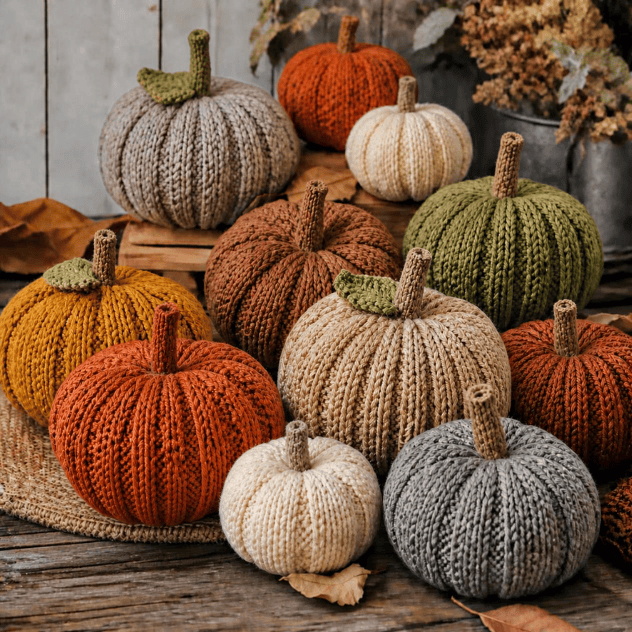
This image is AI generated to show you what different coloured pumpkins look like!
Colours
Why settle for boring orange when your pumpkins can have a whole fall wardrobe? I made the image above with AI to show just how fabulous pumpkins look in literally every autumn color you can imagine. (Your stash just got a lot more interesting, didn’t it?)
rust
golden yellows
brown
beige
ecru and cream
light grey
sage green
HEADS UP: AI is getting weirdly good at making pretty pictures, but it absolutely cannot be trusted to write reliable knitting patterns. (It’s tried. It has not succeeded.) If you’re hunting for more pumpkin ornament patterns, head straight to Ravelry, where you can actually see if other knitters have successfully made the patterns and if they turned out as promised. (Etsy is unfortunately no longer a reliable source for knitting patterns, so keep your yarn budget safe and stay extra skeptical when shopping there):
I whipped up a second pumpkin with thicker yarn because patience is overrated—and it totally worked! Make size M from the pattern, holding 1 strand, and you’ll get a gloriously chonky pumpkin about 12.5″ in diameter and 6″ tall. For the stem, just cast on 12 sts and pretend you absolutely planned it this way all along.
Estelle Bulky: 2 skeins main colour, 1 skein contrast colour (to make a size M you’ll likely need 210m of yarn, and we used scrap yarn for the stem)
There is literally no child who isn’t absolutely adorable in a pumpkin hat. We sized the hat from preemie to kids of all ages, and you should be able to squeeze 2 pumpkin hats out of one skein of yarn (and probably a third green hat too, because why not). The yarn is the gloriously soft Berroco Vintage, which is basically knitting clouds.
Skill Level: Advanced Beginner (i.e., You Know What You’re Doing)
We designed this to be accessible to knitters who are past their first baby steps, so no intimidating colorwork or charts here—just straight-up knitting basics that might actually feel comfortable by now. Here’s what you need to have in your skill toolkit:
Read a knitting pattern
Cast on & Bind off
Knit & Purl in the same row
Work in the round on circular & double pointed needles
Mode At Rowan Alpaca Haze is a blend of super soft alpaca and wool ideal for creating delicate but warm knits Knitters of all skill levels will appreciate the ease with which this yarn glides through their fingers. Mode At Rowan Alpaca Haze is a great substitute for most lace-weight kid-mohair yarn and is great for anyone who is allergic to mohair or finds it itchy. 2 strands held together knits at a worsted/aran tension.
Knitting tension: 18 to 24 sts & 27 to 38 rows = 4″/10cm
3.25mm to 5mm / US3 to 8 needles
Hand wash, lay flat to dry
Made in Peru
Cloud Blouse
The Cloud Blouse is worked from the top down. First the back yoke is worked flat back and forth while short rows are worked to shape the shoulders. Then, each shoulder is worked separately, back and forth and with short rows. The shoulders are then joined to form the front yoke. The front and back yoke are joined at the underarms to form the body, which is worked in the round on a circular needle. The sleeves are worked from stitches that are picked up and knitted along the armhole openings. The sleeves are worked in the round. At the end, the stockinette stitch funnel neckline is worked from stitches that are picked up and knitted along the neck opening.
A spectrum of fluffy yarn blends quietly in this simple seed-stitch cowl. Three strands of laceweight yarn are held together, with one strand periodically changing to a new color to create a soft transition from one color to the next, and back again. This cowl can also be knit as a scarf.
Blouse No. 1 light is a simple, fitted, long-sleeved blouse with a boat neckline. The sleeves are fitted with a bit of flare at the bottom. The neckline is shaped by working short rows, which ensure a great fit. The yoke and sleeves are shaped using the contiguous method, which makes the sweater seamless. Blouse No. 1 light is worked from the top down.
If you want a more dense knitted blouse, you can work the blouse holding three strands of yarn together instead of two – Mode At Rowan Alpaca Haze 8 (8) 9 (9) 10 (11) 12 (12) balls
Joo Sweater Light
Joo Sweater Lightis a light and airy sweater inspired by hanbok, Korean traditional clothing. It is worked top down with raglan increases, and short rows are worked at the back of the beck to shape the neckline. The pattern down from the neckband has raglan increases, before working the body and sleeves in stockinette stitch.
Size
1 (2) 3 (4) 5 (6) 7 (8)
To fit a chest circumference of approx: 85 (90) 95 (100) 110 (120) 130 (140) cm OR 34 (36) 38 (40) 44 (48) 52 (56) inches
Sandnes Garn Cashmere is a soft, light and luxurious yarn made from the underwool of the cashmere goat. The yarn is characterized by a very special softness, and is perfect for garments that need that little extra where comfort and quality are important. Sandnes Garn Cashmere gives an exclusive touch to both small and large projects.
The Uma Scarf is worked from the center and out with increases worked on RS rows. At the end, a contrasting edge is worked along two of the sides of the scarf. If you wish to work the Uma Scarf in a limited amount of yarn (i.e. more or less than the yardage listed on the front page for the size), simply work increases as the pattern dictates until you run out of yarn.
The blue Uma Scarf is knitted in Sandnes Garn Cashmere in the colors Dark navy [5882] and Provence blue [5824] in size medium.
Sizes
small (medium) large
Length: approx. 90 (110) 150 cm [35½ (43¼) 59 inches]
Height: approx. 35 (45) 60 cm [13¾ (17¾) 23½ inches]
The Sophie Scarf is worked back and forth in one piece, from tip to tip in garter stitch with built-in i-cord edges. The smaller size Sophie Scarf reaches around the neck once, while the larger size can wrap around the neck twice.
Size
Small (large)
Length from tip to tip: approx. 80 (102) cm [31½ (40¼) inches]
The peacock scarf starts at the tip. The scarf is then knitted flat in pattern following the chart (or the text). Increases are made on each side when following the chart (or the text).
Size
small (large)
Hight at the center: approx. 15 cm 6“ (22 cm 8.75“)
The Penny Gloves are fingerless gloves worked seamlessly from the cuff to the fingers. They can be worked either on double-pointed needles or on a long circular needle using the Magic Loop technique.
The Barbara Balaclava is worked from the top down in stockinette stitch. First, a square is worked for the top of the head, then stitches are picked up and knitted along both sides of the square, and short rows are worked to round the top of the balaclava. After this the balaclava is worked straight down and then joined in the round below the chin. The neck is worked in the round in stockinette stitch before it is finished with a rib edge. At the end a rib edge is worked along the face opening.
Size
S (M) L
Fits head circumference: 54-56 (56-57) 57-59 cm OR [21¼-22 (22-22½) 22½-23¼ inches]
Width while laying flat: approx. 20 (21) 22 cm OR [7¾ (8¼) 8¾ inches]
The Double Knit Scarf is a short scarf made with double knitting. With its simple and timeless design, it can be enjoyed by anyone, regardless of gender. Recommended for knitters who can maintain even stockinette stitches and are comfortable with the tubular bind-off technique.
Special Techniques & Video Tutorials
Italian (Tubular) Cast On, Slip 1 with yarn in front, Tubular Bind-Off
This pattern includes reference videos! You can find all the video tutorials for this pattern in the “Double Knit Scarf” playlist at the following link – HELLO, HYGGE LIFE YouTube channel: https://www.youtube.com/@hellohyggelife2067
Knit incredibly beautiful ponchos, pullovers, cardigans, legwarmers, hats, mitts, socks, accessories & throws with this velvety soft, bulky-weight yarn. Each quick knitting ball colorfully transitions from hue to hue as you knit. The yarn is created by spinning multiple strands of different colors together to create these multi-colored marls. Each ball has 200g-298m (328 yards) for great project continuity. The acrylic/ wool blend is machine washable & easy to care for. Choose from a fun palette of color stories.
Hat: Finished measurements: Height: 11.5” (29 cm), Circumference: 19.75 (50 cm). Note – hat has been designed to be close-fitting and will stretch to fit.