Does anything say Canada to Canadians more than the iconic Hudson Bay Blanket? It’s simple design is timeless and a hand-knit version would make for a super-special baby gift. The pattern is beginner-friendly (it’s just straight knitting), and makes a great low-brain activity, summer project. And it’s FREE, so that’s a bonus too!
Size
34 inches wide and 39 inches long
NOTE: Garter stitch has a tendency to stretch, so your blanket will “grow” beyond these dimensions.
The Hudson Bay Inspired Baby Blanket is made with worsted weight yarn, so you’ve got several great options to choose from! I’ve colour combined and art-directed the colours, so you don’t have to worry about which shades match and balance together – I’ve got you covered! Working with the palates available from each yarn line, I tired to create as many combinations that looked good as possible. I also tried to go for different aesthetics, the classics are closest to the iconic blankets sold by the Hudson Bay Company, and feature clearer, brighter colours. The subdued combos are a more modern, grown-up take on the hues, and are darker.
Cascade 220 Superwash is an affordably priced, machine washable Peruvian wool yarn. It’s soft enough for baby garments and blankets, knits easily, and has been a staple around here for a LONG time. If you aren’t into synthetics this is a great choice!
classic colours: six skeins of 817 Aran or 871 White, and one skein each of 251 Evergreen, 809 Really Red, 877 Golden, 1924 Midnight Heather
slightly darker colours: six skeins of 817 Aran or 871 White, and one skein each of 1950 Hunter Green, 893 Ruby, 877 Golden, 854 Navy.
Berroco Vintage is a super soft, machine washable blend of wool, acrylic and nylon. It’s easy on the hands and the pocketbook, and is another very popular choice for babies and kids. This yarn is also a longstanding resident around here.
classic colours: six skeins of 5101 Mochi or 5100 Snow Day, and one skein each of 5152 Mistletoe, 5151 Cardinal, 5121 Sunny, 51182 Indigo Heather.
somewhat subdued colours: six skeins of 5101 Mochi or 5100 Snow Day, and one skein each of 5193 Yukon Green, 51181 Ruby Heather, 5127 Butternut, 51182 Indigo Heather.
grown-up heathered colours: six skeins of 5101 Mochi or 5100 Snow Day, and one skein each of 5177 Douglas Fir Heather, 5181 Black Currant Heather, 5192 Chana Dal Heather, 51182 Indigo Heather.
Berroco Vintage Chunky is a slightly thicker version of Berroco Vintage (above), and knits on 6mm/US10 needles. Because this yarn is thicker you’ll need to cast on about 25% fewer stitches (119 sts).
classic colours: six skeins of 6101 Mochi 0r6100 Snow Day, and one skein each of 6152 Mistletoe, 6151 Cardinal, 6121 Sunny, 61182 Indigo Heather.
You can also use Estelle Breeze to make a Cotton version in sorbet baby colours. Breeze is also thicker and works up on 6mm/US10 needles, so you’ll want to cast on 119 stitches.
It just goes to show, you can take the girl out of the library and put her in a store full of yarn, but apparently, you can’t take the library out of the girl!
When I saw Castle Hill I felt sooooo nostalgic for my early days of knitting. It reminds me of the endless parade of cabled pullovers that were all the rage in knitting magazines in the mid 90s. I had a subscription to Vogue Knitting, and even though I didn’t really know what I was doing, I loved looking at the pictures and imagining all the sweaters I could make. And now here it is, back again, and I know what I’m doing now, and this time round there’s an absolute universe of YouTube videos to help me with anything I don’t know. This updated version has a shorter, cropped length and elbow-length sleeves (although you can make them longer if you like).
Knit in Berroco Modern Cotton yarn, Castle Hill is knit in the round from the bottom up to the underarms, where the back and front are completed separately and seamed at the shoulders. Sleeves are knit flat separately and seamed during finishing. The cable pattern is written out, not charted.
Neon colours are great for safety. As a cyclist who’se been hit by a distracted driver, I can attest to the importance of highly-visible clothing for pedestrians. Since then my goal has been to stay out of the hospital, and I always wear neon outerwear when I’m on my bike. The neon makes me much, much more visible to drivers, and I think both parties appreciate that. I’ve noticed that since I started wearing neon, drivers are also a lot nicer to me, and my interactions in traffic are much friendlier – I think they just couldn’t see me before, and now I’m REALLY hard to miss.
My friend David has a visibility impairment, and he wears neon too. He is legally blind, but he doesn’t look it, which makes people think that he can do and see things that he can’t, and they assume that he is aware of things that he isn’t. I recommended he wear neon so people would notice him first, and he says it’s been a total game-changer. On an overcast fall/winter/early spring day, a bright garment, even as small as a hat or a scarf, can make a BIG difference.
Neon colours aren’t really like other colours because they’re so BRIGHT. They are great on their own, but they also look wonderful combined with a neutral like light grey, cream, or even a darker colour like a charcoal grey or black, and even navy (for that lite-brite effect). Pictures speak louder and more effectively than words, so I put together a ‘look-book’ of pattern inspiration (linked above) to give you an idea of what can be done with neons. There are also great colour combinations in the book Neons & Neutrals by Aimee Gille.
You can mellow out a neon and make it a bit more pastel by holding a neon base yarn (Cascade Heritage) with an off-white (or something close) kid-mohair (like Drops Kid-Silk) and marling them. Look for a pattern that combines a Fingering Weight with a Lace Weight yarn. To take it down a few more notches strand it with two strands of kid-mohair or a single strand of brushed alpaca like Drops Brushed Alpaca & Silk. You can see this in projects like Neon Cecil (above) and Stephen West does this frequently to modify the colour.
Bright news! Cascade 220 Superwash Merino is now available in NEON colours! Pink, Orange, Yellow and Green …. you’ll never be missed again! Know someone who takes long walks in the winter? Make ’em a hat and keep them visible, safe and warm.
One skein is enough for a hat, two for a regular scarf (6″ wide), 3 for a larger scarf (8″ wide), 4 for a shawl or wrap, 5+ for a sweater (depending on the size), 10+ for a throw blanket.
Cascade 220 Superwash Merino is a great staple yarn and comes in a plethora of colours. It’s 100% machine washable Merino wool, soft enough for babies and kids. Great for just about everything and anything (except felting).
Neons are also available in a fingering weight superwash merino, Cascade Heritage. Two pinks, two oranges, red, yellow, green, and a purple that didn’t make it to the photo shoot (it’s back-ordered).
Cascade Heritageis a soft, durable, and overall lovely new sock yarn. It’s a super soft blend of superwash merino wool and nylon, so they’ll make your hands and feet happy, but also wear well. 1 skein makes a pair of socks, gloves, mitts, or a hat.
I love this hat because it’s so warm! If you knit it as a beanie it’s 2 layers thick, and if you make it with a folded brim then it is FOUR layers thick. Hallelujah, a winter hat that keeps me warm on the coldest days!
Size
Baby (Toddler, Child/Adult S, Adult M, Adult L, Adult XL)
To fit head circumference: 16(18, 20, 22, 24, 26) inches
Cascade Spuntaneous is a super bulky, single-plied yarn that is buttery soft. Made with 100% extra fine merino wool, its design and texture will have you thinking comfort and favourite in a twisted hank. Spuntaneous lends itself to statement accessories like oversized cowls, hats and capelets.
Cascade Ultra Pima Fine is a super soft and silky, machine-washable pima cotton. Its a sport-weight, and is great for all kinds of projects from baby garments, blankets, amigurumi and toys, sweaters, tops, tees, shawls and wraps, facecloths, shopping bags, etc. It also crochets and weaves beautifully! This yarn is made in Peru and imported directly from the manufacturer to Canada.
Please note, this yarn has been discontinued by the distributor and stock is limited. If you need more than we currently have in stock we are happy to check and see if they have more.
Edie is a simple tee worked with raglan increases from the top down. First you have to work back and forth until V-Neck shaping is complete, then in the round to the end. Short-row shaping for the rounded bottom gives a casual finish. Stitches for short sleeves are picked up after the body is complete, to work the sleeves top down in the round. An optional neck finishing is provided. Sample shows unfinished, raw edges.
Size
XS (S, M1, M2, L, XL, XXL)
Finished bust circumference: 33 (35, 37, 39.5, 42, 45, 49.5) inches OR 83.5 (89, 94.5, 100, 107, 114.5, 125.5) cm
Sample is size XS with approx. 2 inches of positive ease at bust
Crafted with meticulous attention to detail, this top-down crochet masterpiece boasts elegance and versatility. Elevate your wardrobe with its enchanting leaf stitch pattern adorning the yoke, harmoniously juxtaposed with a sleek and understated body. The pattern includes full written instructions, chart and schematic.
Fiorellino is worked seamlessly from the top down. Starting with the neck shaping, short rows are worked back and forth to create a higher back neck. The yoke is then worked in the round to sleeve separation. Increases are worked into the textured part of the yoke, followed by raglan increases for the lower part of the yoke. Sleeve stitches are placed on hold to work the body top down. The short sleeves are worked top down in rounds to the cuffs. No finishing required.
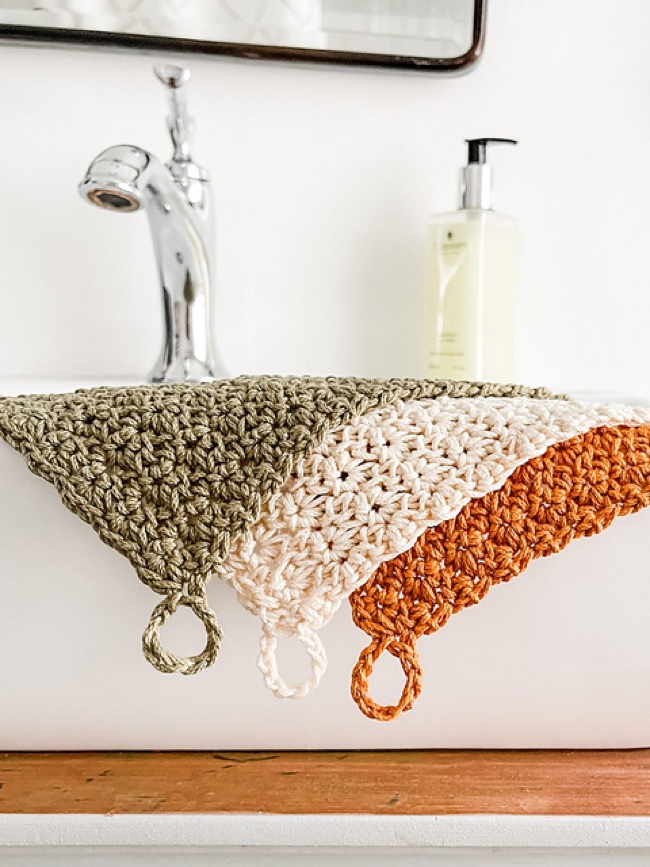
Cascade Ultra Pima Fine: 2 skeins (1 in each of two colours) to make a single dishcloth. To make all 3 towels: Colour A – 3 skeins, Colour B – 2 skeins, Colour C – 2 skeins.
Knitting and Crochet are not only relaxing and creative hobbies but can also be a beautiful way to document and commemorate the passing of time. One popular trend among knitting & crochet enthusiasts is the creation of temperature blankets. These blankets are not only aesthetically pleasing but also serve as a unique way to track and celebrate daily weather patterns throughout the year. Other popular temperature themes projects include scarves, cowls, shawls, sweaters, baby blankets, and even the occasional toy.
A temperature blanket is a project where each row or stitch represents the weather conditions or temperature of a specific day. From cool blues and greens for cold winter days to warm oranges and yellows for hot summer weather, the colours of the blanket change according to a pre-chosen colour scale. Knitters/crocheters typically assign a colour to certain temperature ranges, allowing them to visually depict temperature variations over time.
If you aren’t drawn to the idea of tracking the temperature you can also follow other types of data, like precipitation (I have one client who was making a blanket based on the security alert updates at her university …. you can adapt the idea to any trend or phenomena. Some people make blankets for children based on the weather from the first year of their life.
Temperature blankets also don’t have to be linear – you can make squares, strips or blocks and join them together in any way you like. Plus, one of the major benefits is you don’t need to have to have elaborate skills to make a temperature blanket, the basics go a loooong way!
One of the appealing aspects of knitting a temperature blanket is the ability to personalize the project and choose a colour scheme that resonates with you. You can create your own colour scale or use existing templates available online. Some people prefer using a simple scale (like the colours of the rainbow), assigning a unique colour to a specific temperature range (ie. assign warm colours {pink, red, orange, yellow} to the warmer temperatures and cool colours {green, blue, purple} to the cooler temperatures). Others get more creative, incorporating multiple shades within a range to add depth and texture to their project. Some go for neutrals or keeps things more tonal. If you want to go REALLY off grid, you can choose a bunch of different yarns in similar colours and let the nuances of the different textures take over (be sure to choose yarns that are very close in thickness, for example all worsted weight or all DK weight). It’s totally up to you, there are no rules.
Tracking the temperature
To create a temperature blanket, it is essential to track the temperature each day. You can use various sources such as local weather reports, weather apps, or outdoor thermometers. Maintaining a record of the daily temperature allows you to map out the colours for each row or stitch accurately.
5mm to 6mm tunisian crochet hook (depending on your tension … if you are making short rows like this blanket you may only want to get a 24″ cord for your hook, an extra-long cable may get a little in the way)
Selecting the pattern and yarn
One of the great things about a temperature project, especially a blanket, is you have tons of flexibility in which yarn you choose! Thicker, thinner machine washable, the variables are flexible. Once you have decided on your color scheme, it’s time to choose the pattern and yarn for your temperature blanket. Simple, repetitive stitch patterns like garter stitch or stockinette stitch work well for these projects since they allow the colours to take centre stage.
Most patterns for temperature blankets seem to be designed with DK or Worsted weight yarn. If you want your project to work up faster go for a thicker yarn like Berroco Vintage Chunky, but be sure to adjust your needle size.
I suggest making your blanket in one piece or in larger blocks that are easy to join. If you choose a pattern with small motifs, make sure it’s a “join-as-you-go” technique, otherwise you’ll have a pile of tiny pieces at the ends and may want to commit homicide (or worse).
Knitting a temperature blanket involves a long-term commitment, as it represents an entire year’s worth of weather patterns. Many knitters find the slow progression of this project to be a calming and reflective experience. Each day, as you add a new row or stitch to your blanket, you reflect on the passing of time and the seasons that shape our lives. It becomes a tangible way to record memories and observe the subtle changes throughout the year.
Knitting a temperature blanket not only results in a beautiful and functional creation but also serves as a keepsake to treasure for years to come. Each time you wrap yourself in your blanket, you will be reminded of the effort, patience, and memories that went into its creation. It becomes a personal and unique memento, capturing the story of a year in one cozy and comforting piece.
Knitting a temperature blanket offers a compelling way to blend creativity, mindfulness, and weather tracking into a single project. Whether you are an experienced knitter or a beginner, the appeal of this endeavour lies in the way it allows you to connect with nature, create lasting memories, and express your artistic flair. So, gather your yarn, create your colour chart, and embark on a knitting journey that will result in a beautiful and meaningful temperature blanket.
The kids have been back in school for a month and the temperature is finally starting to feel a little bit more like fall, so it’s time to start thinking about fall and winter accessories!
I whipped up an old standby, the free Gaptastic Cowl, with a couple skeins of a new yarn, Estelle Colour Flair. The Gaptastic Cowl is a super easy knit, very accessible to newer knitters, and it whips up quickly on 8mm/US11 needles. The skills are just casting on in the round, knitting, purling, and binding off. Easy-peasy! If you prefer to make a scarf and you want the long narrow horizontal stripes, you can cast-on without joining in the round and make a scarf lengthwise. We used 2 skeins to make a cowl that’s 9″ deep, but if you want a really big, luxuriously sized scarf or cowl add a third ball.
Colour Flair is a great, soft, bulky to super bulky weight multicoloured wool with a longer colourway, which knits up in stripes. It’s made with 95% non-mulesled wool, so it’s made without hurting the sheep. It’s comes in several bright, pretty colourways, and a few subdued ones too (see pictures below). And at $16.97/ball it’s a very affordable option for a multi-coloured, natural fibre.
Size
9″ deep by 28″ (lying flat)
Materials
Estelle Colour Flair: 2 skeins, shown in colour 43606 (3 skeins if you want it super wide)
Estelle Colour Flair is a multi-coloured super bulky yarn ideal for quick knitting and crochet projects with pops of colour. This thick-and-thin yarn is spun to add texture to your stitches while being lofty and soft. With playful and unique striping colours, Colour Flair is a fun choice for hats, scarves, and blankets. This yarn is made from non-mulesled wool.
The sweater on the mannequin is Algoma, which we made last year with Drops MELODY.
If you’re looking closely and noticing that my edge is looking a bit textured and a little wonky that’s because I tried an alternating cable cast-on – sometimes you gotta try things to see how they work — sometimes you find out why nobody else does it. I didn’t bother ripping back, but I’d also not recommend the fancy cast-on for this project – just do a normal cast-on and you’ll be fine!
It just goes to show, you can take the girl out of the library and put her in a store full of yarn, but apparently, you can’t take the library out of the girl!
I finished my first pair of mittens for Streetknit from last month’s meeting! I was using up some leftover Berroco Vintage Chunky so my mittens are a little less on the matchy-matchy side, but they’re still complementary, and definitely warm. I’m going to try to make one pair a month leading up to the winter so there will be a few more people with warm hands this coming winter.
I used the World’s Simplest Mittens pattern from Tin Can Knits (its an awesome pattern: it covers all sizes and 4 tensions of yarn). I made the second largest size, which fits adult women, but I made the cuffs 2.5″ (shorter than the pattern’s recommended 4″) … my bad, I’ve since learned that when making mittens for the homeless its best to make the cuffs longer. I’ve already cast on my next pair and made the cuffs longer. My finished mitts weight 85g, so one skein of Berroco Vintage Chunky should definitely be enough for one pair of women’s mittens.
I like using Berroco Vintage Chunky for mittens because it’s soft, easy to work with, dense enough to keep out the cold, works up reasonably quickly, is machine washable, and it’s affordable.
FYI: The next Streetknit meetup is Tuesday May 14, 2024: 6 to 9 pm– see below for details!
Mitten Making Resources
As a project mittens tick a lot of boxes, since are much needed by the homeless, and they’re also a quick little project that don’t use a ton of yarn. Skill-wise, I think mitts are in the intermediate-beginner to advanced beginner level (after hats). If you’re feeling inspired to make mittens for the homeless or needly in your community, you can find some resources below for different kinds of patterns and video tutorials.
Streetknit is a grass-roots group of people who have been working for more years than I can count (since at least 2011?) to make, collect and distribute hand knitted items to the homeless. They currently meet once a month at St. Stephens in the Fields Church in Toronto (see the Streetknit Facebook Page for details).
At Knit-O-Matic, we accept donations of hand knitted goods as well as yarn for Streetknit, or you can bring your donations directly to a meeting (or contact Streetknit directly to confirm other drop-off locations). We also host a Yarn Swap a few times a year, and the leftovers go to Streetknit.
Streetknit Meetup Details
NEXT MEETING: Tuesday May 14, 2024: 6 to 9 pm
FREE, all are welcome
St. Stephens in the Fields Church, 103 Bellevue Ave, Toronto ON (use the ramp door)
In consideration of people with chronic health conditions all attending must wear a mask at this event. If you don’t have a mask one will be provided.
Knitting and Crochet are not only relaxing and creative hobbies but can also be a beautiful way to document and commemorate the passing of time. One popular trend among knitting & crochet enthusiasts is the creation of temperature blankets. These blankets are not only aesthetically pleasing but also serve as a unique way to track and celebrate daily weather patterns throughout the year. Other popular temperature themes projects include scarves, cowls, shawls, sweaters, baby blankets, and even the occasional toy.
A temperature blanket is a project where each row or stitch represents the weather conditions or temperature of a specific day. From cool blues and greens for cold winter days to warm oranges and yellows for hot summer weather, the colours of the blanket change according to a pre-chosen colour scale. Knitters/crocheters typically assign a colour to certain temperature ranges, allowing them to visually depict temperature variations over time.
If you aren’t drawn to the idea of tracking the temperature you can also follow other types of data, like precipitation (I have one client who was making a blanket based on the security alert updates at her university …. you can adapt the idea to any trend or phenomena. Some people make blankets for children based on the weather from the first year of their life.
Temperature blankets also don’t have to be linear – you can make squares, strips or blocks and join them together in any way you like. Plus, one of the major benefits is you don’t need to have to have elaborate skills to make a temperature blanket, the basics go a loooong way!
One of the appealing aspects of knitting a temperature blanket is the ability to personalize the project and choose a colour scheme that resonates with you. You can create your own colour scale or use existing templates available online. Some people prefer using a simple scale (like the colours of the rainbow), assigning a unique colour to a specific temperature range (ie. assign warm colours {pink, red, orange, yellow} to the warmer temperatures and cool colours {green, blue, purple} to the cooler temperatures). Others get more creative, incorporating multiple shades within a range to add depth and texture to their project. Some go for neutrals or keeps things more tonal. If you want to go REALLY off grid, you can choose a bunch of different yarns in similar colours and let the nuances of the different textures take over (be sure to choose yarns that are very close in thickness, for example all worsted weight or all DK weight). It’s totally up to you, there are no rules.
Tracking the temperature
To create a temperature blanket, it is essential to track the temperature each day. You can use various sources such as local weather reports, weather apps, or outdoor thermometers. Maintaining a record of the daily temperature allows you to map out the colours for each row or stitch accurately.
5mm to 6mm tunisian crochet hook (depending on your tension … if you are making short rows like this blanket you may only want to get a 24″ cord for your hook, an extra-long cable may get a little in the way)
Selecting the pattern and yarn
One of the great things about a temperature project, especially a blanket, is you have tons of flexibility in which yarn you choose! Thicker, thinner machine washable, the variables are flexible. Once you have decided on your color scheme, it’s time to choose the pattern and yarn for your temperature blanket. Simple, repetitive stitch patterns like garter stitch or stockinette stitch work well for these projects since they allow the colours to take centre stage.
Most patterns for temperature blankets seem to be designed with DK or Worsted weight yarn. If you want your project to work up faster go for a thicker yarn like Berroco Vintage Chunky, but be sure to adjust your needle size.
I suggest making your blanket in one piece or in larger blocks that are easy to join. If you choose a pattern with small motifs, make sure it’s a “join-as-you-go” technique, otherwise you’ll have a pile of tiny pieces at the ends and may want to commit homicide (or worse).
Knitting a temperature blanket involves a long-term commitment, as it represents an entire year’s worth of weather patterns. Many knitters find the slow progression of this project to be a calming and reflective experience. Each day, as you add a new row or stitch to your blanket, you reflect on the passing of time and the seasons that shape our lives. It becomes a tangible way to record memories and observe the subtle changes throughout the year.
Knitting a temperature blanket not only results in a beautiful and functional creation but also serves as a keepsake to treasure for years to come. Each time you wrap yourself in your blanket, you will be reminded of the effort, patience, and memories that went into its creation. It becomes a personal and unique memento, capturing the story of a year in one cozy and comforting piece.
Knitting a temperature blanket offers a compelling way to blend creativity, mindfulness, and weather tracking into a single project. Whether you are an experienced knitter or a beginner, the appeal of this endeavour lies in the way it allows you to connect with nature, create lasting memories, and express your artistic flair. So, gather your yarn, create your colour chart, and embark on a knitting journey that will result in a beautiful and meaningful temperature blanket.