We posted a couple of weeks ago about the sensationally pretty Rosie Sweater (which we have cast-on for the store), and I think her little sister, the Rosie Mittens. The Rosie mittens are a small, manageable project that doesn’t require much yarn, so you might even have some leftovers (or you can cast on for the sweater too and get a little bit of extra yarn for some mitts). The Rosie Mittens would also make a great holiday gift! My favourite yarn for this project is a combination of Drops Alpaca and Drops Kid-Silk held together, but we also list some alternatives too.
Construction The Rosie Mittens are worked from the cuff up. You start with the ribbing, then work in stockinette, with increases for the thumb gusset. The thumb stitches are put on hold, and the pattern is worked. The top of the mitten is worked with decreases. Finally, the thumb is knitted.
I finished my first pair of mittens for Streetknit from last month’s meeting! I was using up some leftover Berroco Vintage Chunky so my mittens are a little less on the matchy-matchy side, but they’re still complementary, and definitely warm. I’m going to try to make one pair a month leading up to the winter so there will be a few more people with warm hands this coming winter.
I used the World’s Simplest Mittens pattern from Tin Can Knits (its an awesome pattern: it covers all sizes and 4 tensions of yarn). I made the second largest size, which fits adult women, but I made the cuffs 2.5″ (shorter than the pattern’s recommended 4″) … my bad, I’ve since learned that when making mittens for the homeless its best to make the cuffs longer. I’ve already cast on my next pair and made the cuffs longer. My finished mitts weight 85g, so one skein of Berroco Vintage Chunky should definitely be enough for one pair of women’s mittens.
I like using Berroco Vintage Chunky for mittens because it’s soft, easy to work with, dense enough to keep out the cold, works up reasonably quickly, is machine washable, and it’s affordable.
FYI: The next Streetknit meetup is Tuesday May 14, 2024: 6 to 9 pm– see below for details!
Mitten Making Resources
As a project mittens tick a lot of boxes, since are much needed by the homeless, and they’re also a quick little project that don’t use a ton of yarn. Skill-wise, I think mitts are in the intermediate-beginner to advanced beginner level (after hats). If you’re feeling inspired to make mittens for the homeless or needly in your community, you can find some resources below for different kinds of patterns and video tutorials.
Streetknit is a grass-roots group of people who have been working for more years than I can count (since at least 2011?) to make, collect and distribute hand knitted items to the homeless. They currently meet once a month at St. Stephens in the Fields Church in Toronto (see the Streetknit Facebook Page for details).
At Knit-O-Matic, we accept donations of hand knitted goods as well as yarn for Streetknit, or you can bring your donations directly to a meeting (or contact Streetknit directly to confirm other drop-off locations). We also host a Yarn Swap a few times a year, and the leftovers go to Streetknit.
Streetknit Meetup Details
NEXT MEETING: Tuesday May 14, 2024: 6 to 9 pm
FREE, all are welcome
St. Stephens in the Fields Church, 103 Bellevue Ave, Toronto ON (use the ramp door)
In consideration of people with chronic health conditions all attending must wear a mask at this event. If you don’t have a mask one will be provided.
Double Sunday is a favourite of PetiteKnit, to the extent where she’s collaborated with the yarn company and added her own palette of colours. Double Sunday is a soft, 100% merino wool, non-superwash double knit weight yarn (3.5mm to 4mm needles). It works up beautifully on its own, or try holding it with a kid-mohair like Drops Kid Silk (see pictures below for colour combinations … you’ll also find them on our website for both products) or a brushed alpaca like Drops Brushed Alpaca & Silk to give it a halo St. Peter would envy. While the ball band says to hand wash, the word on the street is that you can machine wash this yarn on a ‘wool cycle’. No matter what, always wash your hand knits in a delicate bag on delicate so they don’t abrade!
The name is an invitation to embrace the inner rebel and go for a color that truly speaks to you, that could either be a bright pop of color to help you nudge yourself out of your color comfort zone. Or, maybe you’re really craving a toned down color in a soft beige or cream but are hesitant because you always choose the same shades for your projects – well this is the time to listen to whatever speaks to your color loving heart and follow that intuition all the way!
The beanie is worked bottom up on 4 mm (US6) needles with one strand of merino together with one strand of silk mohair to give it a subtle fuzzy sheen.
This little pop-over vest will definitely keep you warm in cool weather! It’s worked holding one strand of kid-mohair with a strand of merino, making it light, airy, and soft.
Size
The Novice Slipover is designed to have approx. 17 cm [6¾ inches] of positive ease, meaning it is designed to be 17 cm [6¾ inches] larger in circumference than your bust measurement. Before beginning your project, measure yourself to determine which size will fit you best. For example, if you measure 90 cm [35½ inches] around your bust (or around the widest part of your upper body) you should knit a size S. A size S sweater has a bust circumference of 107 cm [42¼ inches], which in the given example would give you 17 cm [6¾ inches] of positive ease.
Is it named after the music artist Moby …. I doubt it, but I WISH!
In case the knitting inspiration isn’t already reward enough, here’s a great, TRUE, story from Canadian-famous CBC Radio personality Jonathan Goldstein about Moby (the artist, not the sweater or the whale) …. listenHERE.
The Moby Sweater is worked from the top down in a texture and cable pattern. First the back yoke is worked and shaped using short rows to form the slope of the shoulders. After this, stitches are picked up and knitted for each shoulder, which are then joined to form the front yoke. The front and back yoke are joined to form the body, which is worked straight down in the round. The sleeves are worked in the round on double-pointed needles or on a circular needle using the Magic Loop technique. Finally, stitches are picked up at the neckline to work a ribbed edge, which is then folded over towards the inside to form a double neckband, which is closed by knitting the stitches together with the pick-up edge.
Knit a swatch to determine which needle size you need to achieve the correct gauge – note that this can vary from yarn to yarn. Take care to wash the swatch before measuring, as the texture pattern can grow with wash.
Size
The Moby Sweater is designed to have approx. 15-20 cm [6-8 inches] of positive ease, meaning it is designed to be approx. 15-20 cm [6-8 inches] larger in circumference than your bust measurement. Before beginning your project, measure yourself to determine which size will fit you the best. For example, if you measure 90 cm [35½ inches] around your bust (or around the widest part on your upper body) you should knit a size S. A size S sweater has a bust circumference of 106 cm [41¾ inches] which in the given example would give you 16 cm [6¼ inches] of positive ease.
The Champagne Cardigan is worked from the top down with raglan increases on the yoke and a deep V-neck. The neckline of the cardigan is shaped with short rows by raising the back of the neck. The button plackets are worked in double knitting with buttonholes along the right side.
Size
The Champagne Cardigan has an oversize fit and is designed to have approx. 28 cm [11 inches] of positive ease, meaning it is designed to be 28 cm [11 inches] larger in circumference than your bust measurement. The sizes XS (S) M (L) XL (2XL) 3XL (4XL) 5XL are designed to fit a bust circumference of 80-85 (85-90) 90-95 (95-100) 100-110 (110-120) 120-130 cm (130-140) 140-150 cm [31½-33½ (33½-35½) 35½-37½ (37½-39½) 39½-43¼ (43¼-47¼) 47¼-51¼ (51¼-55) 55-59 inches].
Before beginning your project, measure yourself to determine which size to knit. For example, if you measure 106 cm [41¾ inches] around your bust (or around the widest part of your upper body) you should knit a size XL. A size XL sweater has a bust circumference of 134 cm [52¾ inches] which in the given example would give you 28 cm [11 inches] of positive ease.
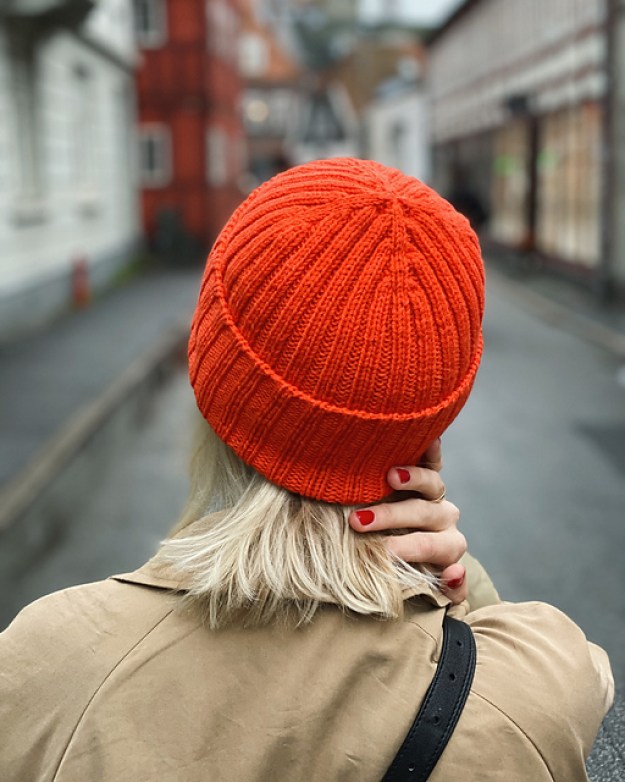
The Hipster Hat is worked bottom-up in a 2×2 rib stitch. The bottom has a folded edge of about 6 (6) 8 (8) cm [2¼ (2¼) 3¼ (3¼) inches] (you can do a double folded edge if you knit the hat extra-long, but bear in mind that this will require more yarn than suggested). The decreases at the top of the head are done by working 2 sts together on each side of two knit sts a total of 4 times across the round. The Hipster Hat can be knit a bit long for it to get a little “hipster top” or to a length where it fits your head snuggly. The Hipster Hat is for both men and women.
Size
baby (child) woman (man)
head circumference of approximately: 45-48 (48-53) 53-57 (57-60) cm [17¾-19 (19-20¾) 20¾-22½ (22½-23½) inches]
The Oslo Hat is worked in two strands of yarn held together from the bottom up in stockinette stitch. The first part of the hat is worked on a 40 cm 16 inches circular needle, while the top of the hat is worked either on double-pointed needles or on a circular needle using the Magic Loop technique.
Size
XS (S) M (L) the approx. equivalent to baby (junior/woman) woman (man)
head circumference of approximately: 47-50 (50-55) 55-59 (59-62) cm [18½-19¾ (19¾-21¾) 21¾-23¼ (23¼-24½) inches]
Hanko has a boxy and relaxed fit that is effortless to wear and style in many different ways. It is my take on the classic Breton stripe style, but with a few little twists such as the two-colour stripes, dropped shoulder line and wide sleeves. Did you also notice the two-colour tubular bind off at the hem and the cuffs?
Hanko is knitted seamlessly top-down. The neckline is folded double, and the top of the back is shaped with German short rows to improve the fit around the neck. The shoulders are sloped and worked by increasing stitches along the shoulder line. After finishing the increases the front and back are separated and knitted separately to create the sleeve openings. After that, the pieces are joined again in the round and worked seamlessly down to the hem. Lastly, stitches are picked up around the sleeve openings and worked in the round. You can easily try the Hanko pullover on as you knit it and adjust the measurements to your own body measurements.
Hanko got its name after the small seaside town in Finland. The town of Hanko is a popular summer destination with beautiful beaches, marinas and old wooden villas dating back to the 19th century.
Size
This garment is supposed to be an oversized fit and features a positive ease of 25 cm / 10 inches.
The Marseille Sweater is worked from the top down. First, the back yoke is worked back and forth, while the shoulder slope is created by working short rows for a good fit. After this, each shoulder is worked back and forth separately with short row shaping. Then, the shoulders are joined to form the front. The front and back are worked separately and joined at the bottom of the armholes, and then the body is worked in the round on a circular needle. The sleeves are worked from stitches that are picked up and knitted along the armholes and are shaped using short rows. The sleeves are worked in the round on a circular needle and double-pointed needles or using the Magic Loop technique. The neck edge is worked from stitches that are picked up and knitted along the neckline, it is then folded double and knitted together. The Marseille Sweater is worked with stripes, the placements of which are described in the pattern.
Size
The Marseille Sweater is designed to have approx. 25 cm [9¾ inches] of positive ease, meaning it is designed to be 25 cm [9¾ inches] larger in circumference than your bust measurement. Before beginning your project, measure yourself to determine which size to knit. For example, if you measure 90 cm [35½ inches] around your bust (or around the widest part of your upper body) you should knit a size S. A size S sweater has a bust circumference of 115 cm [45¼ inches], which in the given example would give you 25 cm [9¾ inches] of positive ease.
Designed to fit a bust circumference of 80-85 (85-90) 90-95 (95-100) 100-110 (110-120) 120-130 cm (130-140) 140-150 cm [31½-33½ (33½-35½) 35½-37½ (37½-39½) 39½-43¼ (43¼-47¼) 47¼-51¼ (51¼-55) 55-59 inches].
Infinitude is a really easy cowl great for knitters both experienced and less-so. A few years ago we made it in a solid colour of Drops Air, and it’s been so popular that I figured it was worth punching up with some colour. We made the smaller size of this cowl with one ball of Berroco Wizard (see our Ravelry notes for dimensions, etc), and while we used the recommended 5.5mm/US9 needles, I think you could go up to a 6mm/US10 with Berroco Wizard. The fabric is light and airy, incredibly soft, slightly textured, and above all else dazzling to the eye (and don’t your eyes deserve something resplendent to rest on?)
After we made our Bente Throw we had some leftovers, and I hate seeing leftovers going to waste (not that yarn goes bad), so we played yarn chicken to see how far our Berroco Wizard bits would go …. it turns out FAR! Our hat weighs just 42g, which means you should be able to make TWO hats with one ball (as long as you buy a pom-pom or go without) or one hat and on pair of mitts (see below).
I used a natural raccoon fur Pom-pom, but you can also opt for synthetic if you like (for this hat I’d go any size natural raccoon pom-pom or a MEDIUM-sized synthetic pom-pom, since the fabric is light and won’t hold the weight of a large or extra large synthetic pom-pom).
The pattern is one size, but the fabric is very stretchy and comfortable fit a 24″ head (including ponytail) – I love magic yarns!!!
Materials
Berroco Wizard: 1 ball (we used 42 g for our hat, colour 2933 Apatite)
I was doing some teaching last week and cast-on for a sock using more of the leftovers (although I’m really running low now) and the free Rye pattern from Tin Can Knits (I have left out the garter stitch detail). If you’ve never made socks before this is an excellent pattern!
Who wants to think about Fall when we’re in the middle of Summer? Me! When I saw Berroco Wizard I knew the projects were winners, and when the yarn for our store samples showed up I knew I’d be happy, but it wasn’t until I cast on that I realized it was BASHERT (a Yiddish term referring to something that is destined, like a soul mate).
I’m making Malou, a simple pullover (see below), in colour 2954 and it’s just sooooo gorgeous. It’s like if Noro and Missoni collaborated and said: “Hey, wouldn’t it be great if we could make everything Haley ever wanted in a yarn?!” I thought the colourway would work up looking more blue, but you know what – I don’t care! It’s GORGEOUS, it’s better than what I wanted it to be, it’s what I need.
Berroco Wizard is a super soft, light & happy bulky weight yarn. It stripes by itself, with bold colors flowing. It has a chainette construction which makes it feel deliciously airy and weightless. The consruction is also respinsible for it’s very generous 240m yardage – the same amount of a typical bulky weight yarn would normally be about 100m to 125m. Wizard is also machine washable, so it’s great for all kinds of projects including blankets, sweaters, hats, scarves, mitts – even a cozy pair of -slipper-socks!
These kits as a special-order and we aren’t stocking them in the store on a regular basis – you have the option to order it any time (it will be available to purchase as long as the manufacturer makes it available to us). Your kit will ship or be available for pick-up once it arrives, and we will contact you. If you need your kit for a specific date please let us know and we can find out if it’s feasible.
Aleid
Aleid is a simple stockinette hat and mitten set, perfect for gifting. Also a great beginner project! You can order the kit as just the hat, just mitts, or both.
Bente is a mosaic stitch blanket using one color of Wizard. Working from two balls simultaneously creates a dynamic color change throughout the blanket. Kits are available in both a throw size and a baby blanket size (see modifications below).
Skill Level: Intermediate-Beginner (after scarves). (Mosaic stitch is an extremely easy form of colour knitting and only involves slipping stitches from the left needle to the right.
Skills: Knit, slipping stitches, following a pattern, alternating balls of yarn (carrying yarn up the side/stripes)
Malou is a simple pullover in Wizard, a great first sweater. Body and sleeves of this garment are worked in the round to underarms. Pieces are then joined and yoke is worked in the round to the neck
Skill Level:
Size
This sweater is designed cropped – to make yours longer please purchase an extra ball of yarn.
Sanne is a must-make cardigan with ¾ sleeves, pockets and cozy shawl collar. It’s a wear-every-day kind of sweater. Shoulders are shaped using short rows and are then joined using 3-needle bind-off. Sleeves are then picked up and worked down. The hem and sides are finished with an applied I-cord.
Skill Level: Intermediate
Size
This sweater is designed cropped – to make yours longer please purchase an extra ball of yarn.
We recently received a shipment of a new staple yarn, Sandnes Garn Double Sunday. Double Sunday is a favourite of PetiteKnit, to the extent where she’s collaborated with the yarn company and added her own palette of colours. Double Sunday is a soft, 100% merino wool, non-superwash double knit weight yarn (3.5mm to 4mm needles). It works up beautifully on its own, or try holding it with a kid-mohair like Drops Kid Silk or a brushed alpaca like Drops Brushed Alpaca & Silk to give it a halo St. Peter would envy. While the ball band says to hand wash, the word on the street is that you can machine wash this yarn (I’ll whip up a swatch and throw it in my next load). No matter what, always wash your hand knits in a delicate bag on delicate so they don’t abrade!
The Hipster Hat is worked bottom-up in a 2×2 rib stitch. The bottom has a folded edge of about 6 (6) 8 (8) cm [2¼ (2¼) 3¼ (3¼) inches] (you can do a double folded edge if you knit the hat extra-long, but bear in mind that this will require more yarn than suggested). The decreases at the top of the head are done by working 2 sts together on each side of two knit sts a total of 4 times across the round. The Hipster Hat can be knit a bit long for it to get a little “hipster top” or to a length where it fits your head snuggly. The Hipster Hat is for both men and women.
Size
baby (child) woman (man)
head circumference of approximately: 45-48 (48-53) 53-57 (57-60) cm [17¾-19 (19-20¾) 20¾-22½ (22½-23½) inches]
The Oslo Hat is worked in two strands of yarn held together from the bottom up in stockinette stitch. The first part of the hat is worked on a 40 cm 16 inches circular needle, while the top of the hat is worked either on double-pointed needles or on a circular needle using the Magic Loop technique.
Size
XS (S) M (L) the approx. equivalent to baby (junior/woman) woman (man)
head circumference of approximately: 47-50 (50-55) 55-59 (59-62) cm [18½-19¾ (19¾-21¾) 21¾-23¼ (23¼-24½) inches]
The Champagne Cardigan is worked from the top down with raglan increases on the yoke and a deep V-neck. The neckline of the cardigan is shaped with short rows by raising the back of the neck. The button plackets are worked in double knitting with buttonholes along the right side.
Size
The Champagne Cardigan has an oversize fit and is designed to have approx. 28 cm [11 inches] of positive ease, meaning it is designed to be 28 cm [11 inches] larger in circumference than your bust measurement. The sizes XS (S) M (L) XL (2XL) 3XL (4XL) 5XL are designed to fit a bust circumference of 80-85 (85-90) 90-95 (95-100) 100-110 (110-120) 120-130 cm (130-140) 140-150 cm [31½-33½ (33½-35½) 35½-37½ (37½-39½) 39½-43¼ (43¼-47¼) 47¼-51¼ (51¼-55) 55-59 inches].
Before beginning your project, measure yourself to determine which size to knit. For example, if you measure 106 cm [41¾ inches] around your bust (or around the widest part of your upper body) you should knit a size XL. A size XL sweater has a bust circumference of 134 cm [52¾ inches] which in the given example would give you 28 cm [11 inches] of positive ease.
Hanko has a boxy and relaxed fit that is effortless to wear and style in many different ways. It is my take on the classic Breton stripe style, but with a few little twists such as the two-colour stripes, dropped shoulder line and wide sleeves. Did you also notice the two-colour tubular bind off at the hem and the cuffs?
Hanko is knitted seamlessly top-down. The neckline is folded double, and the top of the back is shaped with German short rows to improve the fit around the neck. The shoulders are sloped and worked by increasing stitches along the shoulder line. After finishing the increases the front and back are separated and knitted separately to create the sleeve openings. After that, the pieces are joined again in the round and worked seamlessly down to the hem. Lastly, stitches are picked up around the sleeve openings and worked in the round. You can easily try the Hanko pullover on as you knit it and adjust the measurements to your own body measurements.
Hanko got its name after the small seaside town in Finland. The town of Hanko is a popular summer destination with beautiful beaches, marinas and old wooden villas dating back to the 19th century.
Size
This garment is supposed to be an oversized fit and features a positive ease of 25 cm / 10 inches.
The Marseille Sweater is worked from the top down. First, the back yoke is worked back and forth, while the shoulder slope is created by working short rows for a good fit. After this, each shoulder is worked back and forth separately with short row shaping. Then, the shoulders are joined to form the front. The front and back are worked separately and joined at the bottom of the armholes, and then the body is worked in the round on a circular needle. The sleeves are worked from stitches that are picked up and knitted along the armholes and are shaped using short rows. The sleeves are worked in the round on a circular needle and double-pointed needles or using the Magic Loop technique. The neck edge is worked from stitches that are picked up and knitted along the neckline, it is then folded double and knitted together. The Marseille Sweater is worked with stripes, the placements of which are described in the pattern.
Size
The Marseille Sweater is designed to have approx. 25 cm [9¾ inches] of positive ease, meaning it is designed to be 25 cm [9¾ inches] larger in circumference than your bust measurement. Before beginning your project, measure yourself to determine which size to knit. For example, if you measure 90 cm [35½ inches] around your bust (or around the widest part of your upper body) you should knit a size S. A size S sweater has a bust circumference of 115 cm [45¼ inches], which in the given example would give you 25 cm [9¾ inches] of positive ease.
Designed to fit a bust circumference of 80-85 (85-90) 90-95 (95-100) 100-110 (110-120) 120-130 cm (130-140) 140-150 cm [31½-33½ (33½-35½) 35½-37½ (37½-39½) 39½-43¼ (43¼-47¼) 47¼-51¼ (51¼-55) 55-59 inches].
The chart is designed to make the knitting flow, even though the cables are placed closely together. For this reason, all the cables are knitted on the same row, followed by 3 simpler rows. The cable pattern is easy to memorize and not too difficult to knit, even if you haven’t knit cables before. The mittens are knitted bottom-up and the thumbs are knitted at the end, using the ‘’afterthought’’ method.
Size
The mittens are quite stretchy in width, and they will therefore fit a wide range of sizes. The length is adjusted by knitting fewer or more repeats.
S (Small, Womens), L (Large, Womens)
Length: S – 18.5 cm, L – 21 cm (measured without the cuff). Fits hands with palm length S – 16.5-18 cm, L – 18.5-20.5 cm (measured from the wrist to the tip of the longest finger).
Circumference: S and L – 17.5 cm (without stretching, corresponds to 8.5-9 cm width). The circumference is the same in both sizes and can be stretched comfortably to a circumference of 22 cm. The mittens will fit a palm measured around the knuckles’ circumference (without the thumb) of 16 to 22 cm.
Thrumming is a very old technique that is seriously fun and functional. Small tufts of super soft merino roving (wool that hasn’t been spun into yarn yet) are knit into the garment creating a fuzzy warm layer on the inside and irresistible dots of colour the outside. As you wear them, the thrummed roving felts down, keeping your hands warm and cozy (take note dog owners, these are ideal winter dog walking mitts). The mittens will be the colour of the yarn and the thrums (roving) will peek through. Each kit is lovingly hand dyed in Nova Scotia Canada, no two will be exactly alike. (Kit does not include needles: 5.5mm/US4 double-pointed needles.)
Wonder Woolen Yarn
Wonder Woolen is a new-ish yarn from Fleece Artist. It is 100% regionally sourced wool (25 Micron, Woolen Spun). It is heartier and sturdier than the yarns they have used in the past for their thrum kits, and will wear harder, last longer, and keep you warmer. They are so happy with this new yarn at Fleece Artist that they have discontinued all of their other thrum kits. Wonder Woolen is also thicker than the previous yarns used, and knits up faster on larger 5.5mm/US9 needles. If you like the Saltwater Knits series of books by Legrow & Scott you’ll love this yarn!
last year’s pattern was a little weirdly, but it’s been fixed!
New & Improved Kits for 2020!
This year’s kits come with some positive updates ….
Last year there was an error in the pattern which we didn’t catch until we knitted up a pair and made our store-sample (that’s why our sample above looks a bit weirdly). This error has been corrected, so your mitts won’t look weirdly (although we still love ours).
The pattern is now written for ALL adult sizes (small, medium and large).
This year’s colours are a little different too – all the yarn colours are semi-solid and the thrumming is variegated (multicoloured). This creates a mitten with a depth of colour and little random pops of contrasting colour where the thrumming peaks out. No more unpredictable, pooling colours, your mitts will be the colour of the yarn. I also tried to design the kits with colours that are easy to wear and match, and there’s lots for both men and women.
We’ve included some hacks below to make your thrumming experience as smooth as possible!
Skill Level
If you’ve already made a pair of mittens or gloves (with or without fingers) you are ready for thrumming! The concept is the same, just throw in little tufts of roving every once in a while.
Kit Includes
Pattern & instructions for adult size Small, Medium & Large
Yarn: Fleece Artist Wonder Woolen, 113g (100% wool)
Merino Roving: 60g (100% merino wool)
Love
Thrum Hacks!
Here’s a quick little hack to get you started on your thrumming adventure ….
Prepare your thrums BEFORE you start knitting. I estimate for ONE mitten you’ll need about 105(115, 150) thrums for size S(M,L), but you might want to budget a few extras as a buffer (if you find you’ve got extra you can throw them in near the top of the mitt, but it’s better than being short).
Divide your thrums into two piles, one pile for each mitten.
Lay out each pile of thrums on a bandana or tea towel – you can get a general overview of the colour distribution.
Roll up your tea-towel/bandana to keep your thrums safe and tidy. This also makes your thrums PORTABLE.
My friend Rosie just finished a set of mitts made with Cascade 220 Superwash Wave and I think they’re really cool! She used one skein to make all three mitts with the World’s Simplest Mittens pattern (a freebie from the lovely ladies at Tin Can Knits, she made a size Women’s Medium). Why three? Why not?! There was more than enough yarn left to make a third, and you inevitably always misplace or lose one mitten. Anyway, I thought it was pretty cool, having three mitts that match but aren’t exactly alike – it’s like having extra wardrobe options!
The pattern is excellent; a basic mitten knit in the round. It is very straightforward, well written, and the instructions (like all of the Tin Can Knits patterns) are easy to read and follow. It is written for sizes Toddler to Adult Large, and accommodates four different sizes of yarn (fingering, DK, worsted and chunky weight).
Alternatives to DPNs
If you don’t like making mitts because you don’t enjoy using double pointed needles, you might want to try using the new Addi Flexi-flip needles – they’re a great alternative to traditional double pointed needles (Rosie has been using hers since they first came out, and she’s become a convert, despite not having a huge issue with double points to begin with). You could also try using Chaigoo’s 9″ circular needles(you can get them as singles, or if you really like them invest in their interchangeable set) but you will still have to finish the thumb on double pointed needles.
Knit Hack: Matching the Thumbs
Sometimes matching the thumb to the rest of the mitten is tricky with yarns that change colours in stripes or as a gradient. This is because you knit the body of the mitten first, and then go back and do the thumb last – the colourway will have changed by the time you go back to do the thumb. You can see this in the centre mitten in the image above.
If you want your thumb to match the mitten better, wind off a little bit of yarn after you’ve put the thumb gusset on hold, and before proceeding with the body of the mitt. You won’t need a lot of yarn (maybe 5m of worsted weight yarn?), it doesn’t take much to knit a thumb. When you go back to finish the thumb you can use the yarn you wound off and your thumb will blend in beautifully.
Thrumming is a very old technique that is seriously fun and functional. Small tufts of roving (wool that hasn’t been spun into yarn yet) are knit into the garment creating a fuzzy warm layer on the inside and irresistible dots of colour the outside. As you wear them, the thrummed roving felts down, keeping your hands warm and cozy (take note dog owners, these are ideal winter dog walking mitts). The mittens will be the colour of the yarn and the thrums (roving) will peek through. This kit can also be used to make Thrummed Socks (great as house-socks or slippers)! Each kit is individually hand-dyed, no two will be exactly alike. Kit does not include needles: 3.5mm/US4 double pointed needles are required.
Kit Includes
Pattern & instructions (or you can download them free HERE)
Yarn: Fleece Artist Blue Face Leicester Aran, 125g (100% wool)
Roving: 60g (100% wool)
Sizes included: Child, Adult Small, Adult Medium, and Adult Large.
This pattern is one of our oldies but goodies, but sometimes you just need something fast and simple (actually, it’s one of the most popular freebies on our website). One skein of Malabrigo Rasta makes a pair of glorious mittens!