The Berroco Design Team has crafted twelve spectacular 16 x 16″ blocks, each showcasing a unique cable arrangement that’s perfect for knitters eager to dive in and master these mesmerizing stitches. Released on the 2nd Tuesday of each month, each block takes you on an exciting journey through the wonderful world of cables—from classic twists to interesting rope patterns and everything in between.
Eagle-eyed knitters may notice that this year’s Knitalong is inspired by Norah Gaughan, Berroco’s original cable queen, and her complex crowd favorite Norah’s Vintage Afghan. This Year’s KAL adapts and updates a selection of squares to make it a little more approachable and accessible to more knitters. Work your way through the collection at your own pace, discovering new techniques and building confidence with each design.
Joining the KAL is free, as are the patterns and instructions. The patterns for the squares are both written and charted, and there’s an excellent support video for each. Each month’s pattern is published on the second Tuesday of the month, both on the Berroco website and on Ravelry (Cable Craze Blanket KAL 2026), which will update each month with the new Block. If you sign up for their newsletter (see bottom of their website) you’ll get reminders too.
At the end of 2026, finished projects added to Ravelry will be entered to win a mystery prize pack worth $1000 full of yarn, tools, and accessories from Berroco and its partner brands. Make sure to tag your project #VintageKAL26.
Colours
The project was designed with 3 colours (one light, one medium, one dark), but you can do any combination you like. I especially like it monochromatic, or even 3 light neutral shades that are close together.
Size
Completed Blanket: Approximately 50½ ” / 128 cm x 66″ / 167.5 cm
This year’s Knitalong is inspired by this FREE pattern, Norah’s Vintage Afghan. If you like your cables a bit spicier, then feel free and dive into this pattern; the cables are GORGEOUS! Like the KAL, Norah’s Vintage Afghan also uses Berroco Vintage, but it’s a bit more complex, using 5 colours and comprising 20 blocks.
Knitting and Crochet are not only relaxing and creative hobbies but can also be a beautiful way to document and commemorate the passing of time. One popular trend among knitting & crochet enthusiasts is the creation of temperature blankets. These blankets are not only aesthetically pleasing but also serve as a unique way to track and celebrate daily weather patterns throughout the year. Other popular temperature themes projects include scarves, cowls, shawls, sweaters, baby blankets, and even the occasional toy.
A temperature blanket is a project where each row or stitch represents the weather conditions or temperature of a specific day. From cool blues and greens for cold winter days to warm oranges and yellows for hot summer weather, the colours of the blanket change according to a pre-chosen colour scale. Knitters/crocheters typically assign a colour to certain temperature ranges, allowing them to visually depict temperature variations over time.
If you aren’t drawn to the idea of tracking the temperature you can also follow other types of data, like precipitation (I have one client who was making a blanket based on the security alert updates at her university …. you can adapt the idea to any trend or phenomena. Some people make blankets for children based on the weather from the first year of their life.
Temperature blankets also don’t have to be linear – you can make squares, strips or blocks and join them together in any way you like. Plus, one of the major benefits is you don’t need to have to have elaborate skills to make a temperature blanket, the basics go a loooong way!
One of the appealing aspects of knitting a temperature blanket is the ability to personalize the project and choose a colour scheme that resonates with you. You can create your own colour scale or use existing templates available online. Some people prefer using a simple scale (like the colours of the rainbow), assigning a unique colour to a specific temperature range (ie. assign warm colours {pink, red, orange, yellow} to the warmer temperatures and cool colours {green, blue, purple} to the cooler temperatures). Others get more creative, incorporating multiple shades within a range to add depth and texture to their project. Some go for neutrals or keeps things more tonal. If you want to go REALLY off grid, you can choose a bunch of different yarns in similar colours and let the nuances of the different textures take over (be sure to choose yarns that are very close in thickness, for example all worsted weight or all DK weight). It’s totally up to you, there are no rules.
Tracking the temperature
To create a temperature blanket, it is essential to track the temperature each day. You can use various sources such as local weather reports, weather apps, or outdoor thermometers. Maintaining a record of the daily temperature allows you to map out the colours for each row or stitch accurately.
5mm to 6mm tunisian crochet hook (depending on your tension … if you are making short rows like this blanket you may only want to get a 24″ cord for your hook, an extra-long cable may get a little in the way)
Selecting the pattern and yarn
One of the great things about a temperature project, especially a blanket, is you have tons of flexibility in which yarn you choose! Thicker, thinner machine washable, the variables are flexible. Once you have decided on your color scheme, it’s time to choose the pattern and yarn for your temperature blanket. Simple, repetitive stitch patterns like garter stitch or stockinette stitch work well for these projects since they allow the colours to take centre stage.
Most patterns for temperature blankets seem to be designed with DK or Worsted weight yarn. If you want your project to work up faster go for a thicker yarn like Berroco Vintage Chunky, but be sure to adjust your needle size.
I suggest making your blanket in one piece or in larger blocks that are easy to join. If you choose a pattern with small motifs, make sure it’s a “join-as-you-go” technique, otherwise you’ll have a pile of tiny pieces at the ends and may want to commit homicide (or worse).
Knitting a temperature blanket involves a long-term commitment, as it represents an entire year’s worth of weather patterns. Many knitters find the slow progression of this project to be a calming and reflective experience. Each day, as you add a new row or stitch to your blanket, you reflect on the passing of time and the seasons that shape our lives. It becomes a tangible way to record memories and observe the subtle changes throughout the year.
Knitting a temperature blanket not only results in a beautiful and functional creation but also serves as a keepsake to treasure for years to come. Each time you wrap yourself in your blanket, you will be reminded of the effort, patience, and memories that went into its creation. It becomes a personal and unique memento, capturing the story of a year in one cozy and comforting piece.
Knitting a temperature blanket offers a compelling way to blend creativity, mindfulness, and weather tracking into a single project. Whether you are an experienced knitter or a beginner, the appeal of this endeavour lies in the way it allows you to connect with nature, create lasting memories, and express your artistic flair. So, gather your yarn, create your colour chart, and embark on a knitting journey that will result in a beautiful and meaningful temperature blanket.
Over the weekend I went to the Art Gallery and after trolling other people’s art I was feeling very motivated to get on making some of my own. As a warm-up, I’m taking my cue from my excellent friend Rosie and I started a “Square-A-Day” blanket. As you can imagine, a “square-a-day” blanket is the kind of thing where you make a square every day for whatever time you choose (ex. a year?), then join them together.
You can knit or crochet your square-a-day, use any type of yarn, and of course make any type of shape. You could make a rectangle, or a circle, or a triangle, or a hexagon a day blanket – it’s up to you.
It doesn’t matter whether you knit or crochet your squares, it really depends on what you enjoy! I’ve been teaching a lot of crochet lately, and after seeing a lady at the Art Gallery wearing a granny square sweater I was kind of itching to get my hooks out. I also like crochet for blankets because for me it’s a little faster than knitting. The downside of crochet is it uses up about 30% more yarn, but if you are using your square-a-day to move through some stash, then so much the better. Personally, I believe that because it’s a hobby the most important strategy to adhere to is JOY – whatever brings you the most personal pleasure and satisfaction is key.
Square-A-Day Mood Blanket by Iammarsian on Instagram
Yarn
I would stick to one size yarn, to make it easier to join your pieces. If you start with Worsted or DK, stay in that weight range. I would definitely choose a thickness or tension that is very common and easy to match, like Fingering, DK, or Worsted weight. This way, when you need to get more yarn, it’s easy to find something. These are also yarn weights that are fairly simple to seam in the end. Inevitably, once you get going you’ll like how a few colours are looking and want to fill in with more.
BlanketSize
Before you start, You should consider what size blanket you want to make, which will help you decide how many squares you need to make, and what size your squares should be.
Square Size:
Decide on the size (for example, we’ll use a throw of 50″ by 60″ over a period of 365 days)
Multiply the blanket dimensions (50 inches x 60 inches = 3000 inches squared)
Divide the number your calculator just spat out by the number of days you are working on it (3000/365 = 8.219 inches squared)
Press the square root button on your calculator (square root of 8.219 is 2.87 inches).
If you are seaming your squares round up a little (2.87 can go up to 2.9 or 3)
My squares need to be around 3″ x 3″ if I want to make one per day for a year and end up with a throw that’s at least 50″ x 65″.
Square Distribution
You may also want to figure out how many squares you actually need … because 365 might not be the optimal number of squares for your blanket.
Divide the width of your blanket by the width of your squares and round up to the next whole number (50″/3″ = 16.66 …. rounded up to 17)
Divide the height of your blanket by the width of your squares and round up to the next whole number (60″/3″ = 20)
Multiply the two numbers (17 x 20 = 340)
The actual number of squares I need is 340 … perfect for a project started a month late into the year!
This is a long term project, so whatever you choose, make sure it will keep you entertained and stimulated. I’m a colour person, so I’m leaning into that, knowing that no matter what kind of mood I’m in today, a year of neutrals or dark colours will starve my spirit.
Go crazy with colour and experiment with using the colour your resonate with every day. You’ll get a picture of where you were at through the year. You can go random, make a moodblanket and assign a specific colour for the mood you’re in when you’re making your daily square (kind of like a weather blanket, but for emotional states).
Go monochrome and experimenting with blending all the blues available in a yarn, or a bunch of greys and blacks, or browns and neutrals.
Choose a yarn with a co-ordinating palette and smaller 50g balls like Sandnes Garn Double Sunday or Berroco Vintage Baby and just get one of each and let the yarn figure it out for itself.
Some people join the squares as they go, which gives you an interesting perspective on where you were at throughout the year. Others make their shapes individually and join them at the end. I love the aesthetic control you have over placement when you don’t join as you go, but I think the prospect of seaming a bunch of little squares at the end of a long project will make me want to stick a fork in my thigh. I’m doing a hybrid and making my squares in strips and then seaming them. This is an exercise in knowing your limit and crafting within it.
Join as you Go
Joining as you go is an option (see videos below), but it comes with a hitch – as your project gets bigger it loses its portability and bets physically burdensome. If you are crocheting motifs, there is a hybrid option – you can do a final round in a single colour which joins them all as you go: see instructions HERE.
I’m totally winging my blanket and trying to embrace a little bit of chaos …. I’m crocheting using fingering weight yarn I’ve had in my stash and a 3mm crochet hook. I didn’t measure or blanket out my square sizes, I just started going. I’m not a fan of lots of seaming, but I want my project to be portable, so I’m making the squares in strips and then I’ll seam them together. One thing I love about crochet is I can weave in/tack down the ends as I change colours. I experimented a little a settled on a simple single crochet stitch. My first strip of squares measure about 2.5″/6cm wide over 15 stitches. I’m trying to lean into the scrappy aesthetic, so I’m combining both semi-solid and variegated yarns.
Rosie’s Blanket
Rosie is also using up some stashed fingering weight yarn. She’s using a 4mm crochet hook and making classic granny squares in 4 tires/rounds.
Project Ideas You Won’t See On Instagram
Squares are awesome, but there is also something very satisfying and very liberating about an irregular shape. Irregular, asymmetrical shapes are what nature is made of! Plus, when you put them together they hide a multitude of sins …. no straight edges that need to line up.
Personally, I’ve always loved the idea of a throw that looks like a giant baroque doily, like the Temair Throw by Nicky Epstein.
Lots of people make squares and hexagons, but what the world needs more of is Paisleys … by Teva Durham, either in Crochet or Knitted. Would you do a paisley-a-day?
Would you make a circle a day and cobble them together into a patchwork, like this Circle Blanket? If you’re a crocheter you can easily so the same thing with dots!
Knitting and Crochet are not only relaxing and creative hobbies but can also be a beautiful way to document and commemorate the passing of time. One popular trend among knitting & crochet enthusiasts is the creation of temperature blankets. These blankets are not only aesthetically pleasing but also serve as a unique way to track and celebrate daily weather patterns throughout the year. Other popular temperature themes projects include scarves, cowls, shawls, sweaters, baby blankets, and even the occasional toy.
A temperature blanket is a project where each row or stitch represents the weather conditions or temperature of a specific day. From cool blues and greens for cold winter days to warm oranges and yellows for hot summer weather, the colours of the blanket change according to a pre-chosen colour scale. Knitters/crocheters typically assign a colour to certain temperature ranges, allowing them to visually depict temperature variations over time.
If you aren’t drawn to the idea of tracking the temperature you can also follow other types of data, like precipitation (I have one client who was making a blanket based on the security alert updates at her university …. you can adapt the idea to any trend or phenomena. Some people make blankets for children based on the weather from the first year of their life.
Temperature blankets also don’t have to be linear – you can make squares, strips or blocks and join them together in any way you like. Plus, one of the major benefits is you don’t need to have to have elaborate skills to make a temperature blanket, the basics go a loooong way!
One of the appealing aspects of knitting a temperature blanket is the ability to personalize the project and choose a colour scheme that resonates with you. You can create your own colour scale or use existing templates available online. Some people prefer using a simple scale (like the colours of the rainbow), assigning a unique colour to a specific temperature range (ie. assign warm colours {pink, red, orange, yellow} to the warmer temperatures and cool colours {green, blue, purple} to the cooler temperatures). Others get more creative, incorporating multiple shades within a range to add depth and texture to their project. Some go for neutrals or keeps things more tonal. If you want to go REALLY off grid, you can choose a bunch of different yarns in similar colours and let the nuances of the different textures take over (be sure to choose yarns that are very close in thickness, for example all worsted weight or all DK weight). It’s totally up to you, there are no rules.
Tracking the temperature
To create a temperature blanket, it is essential to track the temperature each day. You can use various sources such as local weather reports, weather apps, or outdoor thermometers. Maintaining a record of the daily temperature allows you to map out the colours for each row or stitch accurately.
5mm to 6mm tunisian crochet hook (depending on your tension … if you are making short rows like this blanket you may only want to get a 24″ cord for your hook, an extra-long cable may get a little in the way)
Selecting the pattern and yarn
One of the great things about a temperature project, especially a blanket, is you have tons of flexibility in which yarn you choose! Thicker, thinner machine washable, the variables are flexible. Once you have decided on your color scheme, it’s time to choose the pattern and yarn for your temperature blanket. Simple, repetitive stitch patterns like garter stitch or stockinette stitch work well for these projects since they allow the colours to take centre stage.
Most patterns for temperature blankets seem to be designed with DK or Worsted weight yarn. If you want your project to work up faster go for a thicker yarn like Berroco Vintage Chunky, but be sure to adjust your needle size.
I suggest making your blanket in one piece or in larger blocks that are easy to join. If you choose a pattern with small motifs, make sure it’s a “join-as-you-go” technique, otherwise you’ll have a pile of tiny pieces at the ends and may want to commit homicide (or worse).
Knitting a temperature blanket involves a long-term commitment, as it represents an entire year’s worth of weather patterns. Many knitters find the slow progression of this project to be a calming and reflective experience. Each day, as you add a new row or stitch to your blanket, you reflect on the passing of time and the seasons that shape our lives. It becomes a tangible way to record memories and observe the subtle changes throughout the year.
Knitting a temperature blanket not only results in a beautiful and functional creation but also serves as a keepsake to treasure for years to come. Each time you wrap yourself in your blanket, you will be reminded of the effort, patience, and memories that went into its creation. It becomes a personal and unique memento, capturing the story of a year in one cozy and comforting piece.
Knitting a temperature blanket offers a compelling way to blend creativity, mindfulness, and weather tracking into a single project. Whether you are an experienced knitter or a beginner, the appeal of this endeavour lies in the way it allows you to connect with nature, create lasting memories, and express your artistic flair. So, gather your yarn, create your colour chart, and embark on a knitting journey that will result in a beautiful and meaningful temperature blanket.
Your response to this project was super positive, but you wanted more colour inspiration, so I broke out ye olde camera and had some fun coming up with a bunch more colour combinations for SHARON’S GLAMPING BLANKET 2. I tried to focus on baby blanket friendly colours, neutrals colour combos (you know, the brown palettes, greys), a couple of Christmas combos (for those of you who like to celebrate with a comprehensive decorative theme including a festive throw), a few monochromatic palettes, and a few I lifted from my research (because either people’s brilliance should be celebrated and shared too). Scroll down to see all the colours I’ve come up with, and a few awesome colour combos in the first projects other people made with original Sharon’s Glamping Blanket.
Casapinka is back with a sequel to her extremely popular Sharon’s Glamping Blanket (from 2020) …. SHARON’S GLAMPING BLANKET 2! Yes, if you liked Sharon’s first blanket, you’re sure to love her second! The knitted blanket features bands of fun stitch patterns and stripes making it an engaging project with an eclectic aesthetic.
This playful blanket is made with Berroco Vintage Chunky. This bestselling blend of wool & synthetic fibres is soft, easy to knit with, and is very machine washable! It’s perfect for kids, adults, seniors, picky-men, and cats (Sharon).
If you aren’t sure how your colours balance, take a picture of them with your phone and change the colour filter to a back & white setting (like NOIR on iPhones). This is the colour combo in the picture of the blanket above with the cat:
Colour A – The second lightest colour (6125 Aquae)
The Great Lakes Throw is a super simple blanket anyone can whip up QUICK! It’s made with super bulky weight Cascade Cotton Puff and knits on 15mm/US19 needles for maximum satisfaction. The yarn is a soft, machine-washable cotton tube with a springy polyfil core (like the stuff in pillows and stuffed animals), giving it body and ease of use (it’s also allergy friendly and vegan).
The pattern is a simple, elegant, reversible rib, suitable for all knitters from beginners on up. Sizes range from a baby blanket to king-sized bed. Each ball of Cascade Cotton Puff is 200g/7.05oz, so while this technically isn’t a ‘weighted blanket’, it has some weight to it! Our sample is the Medium Throw 45″ x 60″ and is knit in colour 04.
Size
Baby (Medium Throw, Large Throw, Twin Bed, Double Bed, Queen Bed, King Bed)
Inches: 35 x 42 (45 x 60, 55 x 70, 65 x 90) {85 x 90, 95 x 100, 105 x 100} inches
Centimetres: 87.5 x 10⁵ (112.5 x 10⁵, 137.5 x 175, 162.5 x 225) {212.5 x 225, 237.5 x 250, 262.5 x 250) cm
Our sample is the Medium Throw 45″ x 60″ and is knit in colour 04
Alternately use a super bulky weight yarn that calls for 12mm/US17 to 15mm/US19 needles and knits at 8 sts/4”(10cm): 485 (890, 1270, 1925) {2520, 3125, 3455} metres OR 532 (977, 1393, 2112) {2765, 3429, 3791} yards
We’ve finished up a bunch of samples made with Berroco Wizard, which I’ll be sharing in the next few days …. they’re turning out soooooo beautifully, it’s definitely my favourite new yarn of the year! Wizard is super soft, light, airy, colourful, and slightly textured – perfect for the process and the product knitter in us all! Plus it;s machine washable, so it’s open season for kids & baby knits, sockies & etc. I just finished Malou in it, and I’m already planning to cast on for a second in a different colour. Nuff said?
Bente is a super soft & squishy mosaic stitch blanket made using one color of Wizard. It also works up relatively quickly on 8mm/US11 needles. The painterly colour effects come from working from two balls simultaneously (don’t worry, it’s easy). Our kits are available in both a throw size and a baby blanket size (see modifications below), since the yarn is machine washable.
Skill Level: Intermediate-Beginner (after scarves). (Mosaic stitch is an extremely easy form of colour knitting and only involves slipping stitches from the left needle to the right.
Skills: Knit, slipping stitches, following a pattern, alternating balls of yarn (carrying yarn up the side/stripes)
Berroco Wizard is a super soft, light & happy bulky weight yarn. It stripes by itself, with bold colors flowing. It has a chainette construction which makes it feel deliciously airy and weightless. The consruction is also respinsible for it’s very generous 240m yardage – the same amount of a typical bulky weight yarn would normally be about 100m to 125m. Wizard is also machine washable, so it’s great for all kinds of projects including blankets, sweaters, hats, scarves, mitts – even a cozy pair of -slipper-socks!
Who wants to think about Fall when we’re in the middle of Summer? Me! When I saw Berroco Wizard I knew the projects were winners, and when the yarn for our store samples showed up I knew I’d be happy, but it wasn’t until I cast on that I realized it was BASHERT (a Yiddish term referring to something that is destined, like a soul mate).
I’m making Malou, a simple pullover (see below), in colour 2954 and it’s just sooooo gorgeous. It’s like if Noro and Missoni collaborated and said: “Hey, wouldn’t it be great if we could make everything Haley ever wanted in a yarn?!” I thought the colourway would work up looking more blue, but you know what – I don’t care! It’s GORGEOUS, it’s better than what I wanted it to be, it’s what I need.
Berroco Wizard is a super soft, light & happy bulky weight yarn. It stripes by itself, with bold colors flowing. It has a chainette construction which makes it feel deliciously airy and weightless. The consruction is also respinsible for it’s very generous 240m yardage – the same amount of a typical bulky weight yarn would normally be about 100m to 125m. Wizard is also machine washable, so it’s great for all kinds of projects including blankets, sweaters, hats, scarves, mitts – even a cozy pair of -slipper-socks!
These kits as a special-order and we aren’t stocking them in the store on a regular basis – you have the option to order it any time (it will be available to purchase as long as the manufacturer makes it available to us). Your kit will ship or be available for pick-up once it arrives, and we will contact you. If you need your kit for a specific date please let us know and we can find out if it’s feasible.
Aleid
Aleid is a simple stockinette hat and mitten set, perfect for gifting. Also a great beginner project! You can order the kit as just the hat, just mitts, or both.
Bente is a mosaic stitch blanket using one color of Wizard. Working from two balls simultaneously creates a dynamic color change throughout the blanket. Kits are available in both a throw size and a baby blanket size (see modifications below).
Skill Level: Intermediate-Beginner (after scarves). (Mosaic stitch is an extremely easy form of colour knitting and only involves slipping stitches from the left needle to the right.
Skills: Knit, slipping stitches, following a pattern, alternating balls of yarn (carrying yarn up the side/stripes)
Malou is a simple pullover in Wizard, a great first sweater. Body and sleeves of this garment are worked in the round to underarms. Pieces are then joined and yoke is worked in the round to the neck
Skill Level:
Size
This sweater is designed cropped – to make yours longer please purchase an extra ball of yarn.
Sanne is a must-make cardigan with ¾ sleeves, pockets and cozy shawl collar. It’s a wear-every-day kind of sweater. Shoulders are shaped using short rows and are then joined using 3-needle bind-off. Sleeves are then picked up and worked down. The hem and sides are finished with an applied I-cord.
Skill Level: Intermediate
Size
This sweater is designed cropped – to make yours longer please purchase an extra ball of yarn.
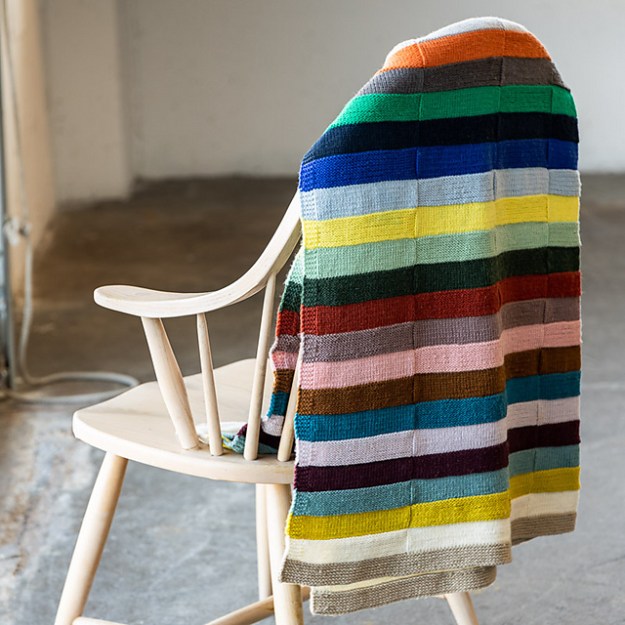
As per your request, I’ve reshuffled the Blanket of Joy kit to include both a worsted weight (4.5mm/US7 needle) and a chunky/bulky weight (6mm/US10 needle) option. I had to play around a bit with the colours for the Chunky weight, but getting the project done faster may have more value to you than having the colours ‘just-so’. Additionally, a few people found the pattern unclear in some places (myself included) so I made revisions to clarify everything and even drew up a chart for you to keep track row by row.
The Blanket of Joy is a simple knit, which is also important right now … Keep It Simple, am I right? Simple bands of colour are knit in offset segments of stocking and reverse stocking stitch to create an easy, graphic combination of colour and texture. Sometimes the simplest solutions are the most brilliant! Need some help with weaving in the ends? Check out our Skills Page!
In the book Joyful, Ingrid Fetel Lee talks about the revitalization of the run-down, crime-ridden city of Tirana, Albania … which was initiated with the very easy and affordable approach of painting buildings bright colours. I’ll leave the details for you to read up on (the book was really good), but if painting a run-down building bright orange can initiate the transformation of a city, maybe it’s not too far a stretch to posit that a joyfully coloured blanket can initiate positive change in a life?
I’m in the Dominican Republic this week … but I promise I’m still thinking of you! While I’m gone, here’s a popular favourite ….. the four points blanket is a great project all year round. It’s available in both knit and crochet, and you can make it in a baby blanket size or as a throw. It’s a simple composition and can be made in a number of different yarn options. The patterns are free, so you can read them over and see if they work for you without committing. If you want something a bit more jazzy, try the Easy Puzzle Blanket, which uses 6 colours.
MODIFICATIONS
use 3.75mm/US5 to 4mm/US6 needles
for a crib (throw) size cast on approximately 140(204) sitches. You will pick up & knit the same number of stitches.
Berroco Vintage Baby is a new yarn that just cam out this spring. It’s very similar to it’s sibling Vintage DK, but it has a slightly silkier texture and comes in 50g balls. It’s soft, easy to work with, machine washable, reliable and is generally great on both the skin and the wallet. The yarns in the Vintage line are a blend of wool and synthetic, and generally work well for people with sensitive skin. We carry this yarn all year.
KNIT 4 Points Baby: 3 skeins in each of 4 colours ($59.64)
KNIT 4 Points Throw: 5 skeins in each of 4 colours ($99.40)
CROCHET 4 Points Baby: 4 skeins in each of 4 colours ($79.52)
CROCHET 4 Points Throw: 7 skeins in each of 4 colours ($139.16)
Berroco Vintage DK is a staple around here, we sell tons of it for every kind of project for babies, grown-ups, and everything in-between. It’s soft, easy to work with, machine washable, reliable and is generally great on both the skin and the wallet. The yarns in the Vintage line are a blend of wool and synthetic, and generally work well for people with sensitive skin. We carry this yarn all year.
KNIT 4 Points Baby Blanket: 2 skeins in each of 4 colours ($79.76)
KNIT 4 Points Throw Blanket: 4 skeins in each of 4 colours ($159.52)
CROCHET 4 Points Baby Blanket: 2 skeins in each of 4 colours ($79.76)
CROCHET 4 Points Throw Blanket: 4 skeins in each of 4 colours ($159.52)
For several years Cascade Ultra Pima has been the go-to yarn for these projects. Its silky soft texture is seductive, and it’s ideal for babies as it’s machine washable, allergy-friendly and excellent for warm climates (no animal fibres in it), and comes in a bunch of great colours.
KNIT 4 Points Baby Blanket: 2 skeins in each of 4 colours ($95.76)
KNIT 4 Points Throw Blanket: 4 skeins in each of 4 colours ($191.52)
CROCHET 4 Points Baby Blanket: 2 skeins in each of 4 colours ($95.76)
CROCHET 4 Points Throw Blanket: 4 skeins in each of 4 colours ($191.52)